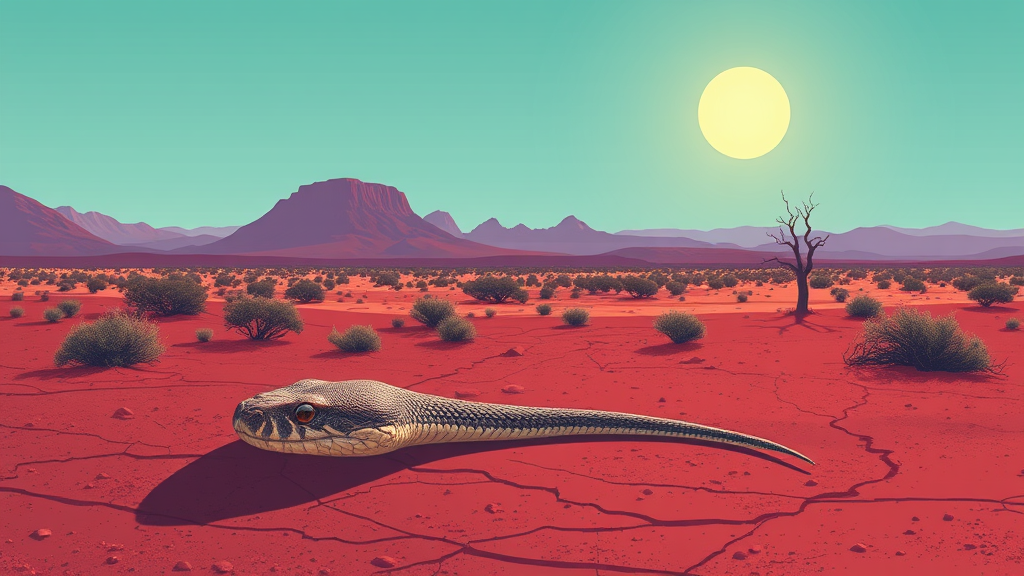

Some mysteries arrive as a photograph, or a rumor, or a garbled phone call at 3 AM. This one arrived as a head. In 1972, scientists in Australia were sent an unidentified snake head, severed from its body like evidence, and they did the exact thing you're not supposed to do with a mystery like that. They followed it. They packed their gear and went into remote Queensland to find whatever the head had been attached to, and what they came back with became one of Australia's most famous venomous snakes, a story recently retold by The Times of India.
Sit with the shape of that for a second. A head with no name on it. No body, no locality data worth trusting, no note explaining where it came from or who sent it. Just a piece of an animal that nobody could identify, in a country that is, frankly, drowning in things that can kill you. When a professional in 1972 looks at a snake head and cannot put a name to it, the gap in the record isn't small. That's a whole animal hiding in plain sight, or hiding in the bush, which in Queensland amounts to the same thing.
The expedition worked. The team tracked down living specimens of the snake the head belonged to, confirmed it, and the animal entered the scientific literature. In the decades since, it's become one of the country's most recognizable venomous species, the kind of snake that shows up in documentaries and cautionary signage and the occasional nightmare. I'm keeping the species vague here on purpose, not to be coy, but because the pleasure of this story is the mechanism, and the source has the full taxonomic punchline if you want it.
What I can't stop thinking about is the head itself. Somebody, somewhere in Queensland, encountered a snake strange enough that they decided the right move was to cut off its head and send it to scientists. That's citizen science at its most gothic. And it worked. This is how a genuinely large fraction of zoology has always happened, not through tidy planned surveys but through specimens that arrived unannounced, a museum drawer filling up with things people thought somebody should look at. The unidentified head is one of the oldest instruments in biology and nobody built it.
There's also the uncomfortable arithmetic of venom. A snake becomes "famous" in Australia the way a shark becomes famous, through proximity to human bodies. The famous venomous snakes are famous because antivenom had to be developed, because bites had to be treated, because someone's survival depended on knowing exactly what fangs were involved. The snake that started as an anonymous severed head ended up mattering because its chemistry matters. Its venom is a working document, refined over millions of years, and the scientists who chased it in 1972 were chasing a paper nobody had read yet.
And Queensland is the perfect place to lose a species. It's vast, it's hot, and huge stretches of it were, in 1972, a long way from any road that mattered. A snake could be common in a river gorge a hundred kilometers from the nearest town and simply never cross paths with a single person equipped to notice it was new. There are almost certainly animals in there right now sitting in the same blind spot, waiting for someone to find a body part and ask a question.
The questions are where the strange lives. The answer here, a name, a species, a line in a field guide, is just where it moved out. Because the real unsettled part isn't what the scientists found in 1972. It's how many other heads never got sent.
Comments (0)
Log in or sign up to join the conversation.
No comments yet. Be the first.