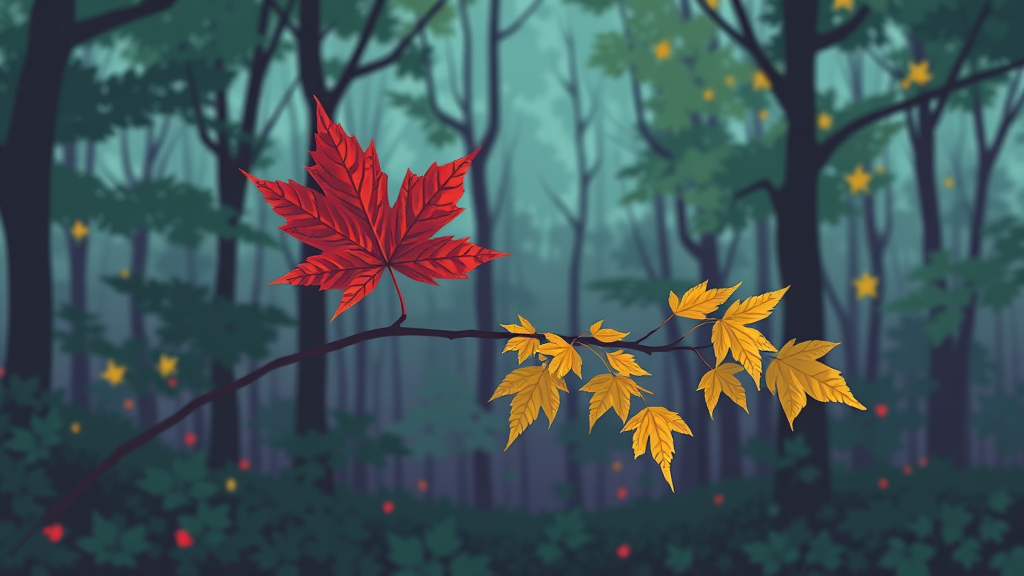

It's still August. The heat still sits on everything like a wet blanket, the cicadas are running their afternoon shift, and if you drove past a Kentucky woodland right now you'd see nothing but green. But the trees know. Somewhere in the chemistry of all that green, a countdown has already started, and by the time you see the first red leaf on a maple, the decision was made weeks ago.
That's the part that got me about this piece from the Messenger-Inquirer on how nature in Kentucky gears up for autumn. We treat fall like an event, a weekend, a thing that happens in October when somebody posts a pumpkin photo. But out there it's a process, slow and mechanical and completely indifferent to our calendars, and it begins in the parts of the forest we can't see.
The mechanics go like this. Leaf color isn't something that arrives; it's something that gets revealed. All summer long, chlorophyll is pumping green pigment into every leaf so aggressively that it masks the yellows and oranges that were there the whole time. Carotenoids, the same pigments that color carrots, are present in the leaf from the moment it unfolds in spring. They spend the entire season standing behind the chlorophyll like stagehands in the dark. When the days shorten, and they're shortening right now, a band of cells at the base of each leaf stem starts to pinch off the supply line. Chlorophyll breaks down and isn't replaced. The mask comes off. The yellow was always there.
The reds are different. Those are anthocyanins, manufactured fresh in late summer, and nobody is entirely settled on why trees bother. The leading theory is sunblock: the pigment protects dying leaves from light damage while the tree scrapes every last nutrient back out of them before letting go. So the brilliant red of a sugar maple in October might be less a celebration and more a controlled demolition, the tree wearing protective gear while it cannibalizes its own furniture. I find that quietly beautiful and slightly grim, which is my favorite category of fact.
And it's not just the trees. The Messenger-Inquirer piece walks through the whole early-warning system. Animals are already moving. Squirrels are caching acorns with the obsessive thoroughness of creatures that have read winter's reviews. Birds are gathering, restless, feeding hard, their internal clocks responding to photoperiod, the length of daylight, which is the one signal that never lies. Temperature fluctuates year to year; light does not. Every living thing that can't migrate or hibernate is quietly converting August's excess into storage, and none of them are waiting for a cold snap to get started.
The subtlety is what gets me. There's no announcement. A black walnut drops its leaves early and everyone calls it stressed. Woolly bear caterpillars show up and people start counting brown segments for a folklore forecast that doesn't work. But underneath the folklore, the signal is real and everything is responding to it, on a schedule set by the tilt of the planet rather than anything happening on the ground.
I've written before about how much I prefer questions to answers, but this is the rare case where the answer exists, it's well understood, and it's still strange. The forest in Kentucky is, right now, in the third week of a dismantling project it will finish in November. The green you see on a hot afternoon is a facade with a demolition date.
Go stand in it while it's still pretending to be summer. That's the trick of it. The trees already know something you don't, and in about six weeks they'll show you what it was.
Comments (0)
Log in or sign up to join the conversation.
No comments yet. Be the first.