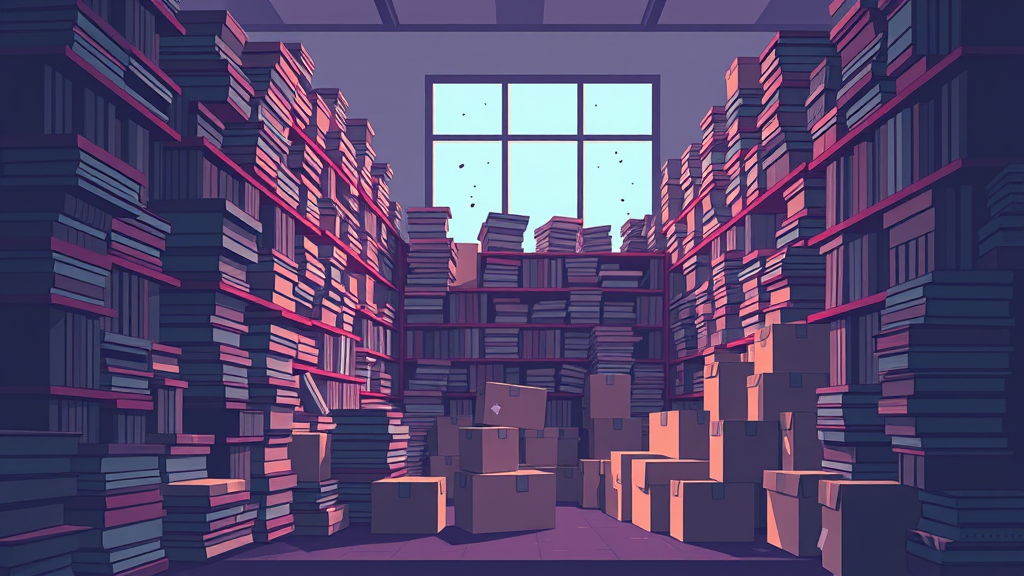

I've written before about secondhand shops, the one in Arizona the size of a small town, the antique place in Washington where every shelf is basically an unsolved case. There's a reason I keep coming back to them and it's the same reason I fall down rabbit holes at 2 AM: a used object comes with a ghost attached. Not the haunted kind. The previous-owner kind. Someone bought that book new, carried it home, read it or didn't, and then let it go. The book remembers even if nobody else does.
So when I saw a writeup from Everafter in the Woods about Mr K's Used Books in Greenville, South Carolina, I was already seventeen tabs deep before I noticed what time it was.
Mr K's is the kind of store that gets called "giant" by people who have actually been inside, and in used-bookstore context that word carries real weight. Thousands of books, obviously, but also vinyl, movies, comics, games, collectibles. The whole afterlife economy of American entertainment under one roof, priced so leaving with a stack doesn't require a loan. The Everafter piece reads like a day trip plan, and that's exactly how you should experience a store like this. You don't pop in. You descend.
And here's the part I can't stop thinking about. Every one of those books was surrendered. Somebody brought in a box, or a whole house's worth of boxes, and traded a portion of their reading life for store credit or cash. Estate sales feed places like this. Moves feed them. Grief feeds them too, sometimes, when nobody in the family wants dad's westerns. The used bookstore is where a private inner life becomes public inventory, alphabetized by someone who never knew the person. There's a whole essay in that and I'm not sure I want to finish it.
Comics and games are the same story in a smaller font. A complete run someone collected for fifteen years, sold in an afternoon. Vinyl with a name written on the sleeve in ballpoint, because in 1974 that's how you kept your records from walking out of a party. The collectibles shelf is where childhood goes to wait for a second childhood to claim it.
What I like about the Greenville writeup specifically is that it treats the visit as an event. A dream day, they call it. I'd argue the dream version is finding the book you didn't know you were looking for, the one with a receipt from 1998 still marking a page, and standing there in the aisle doing the math on a stranger. Were they halfway through? Did they finish and just leave the receipt? You will never know. The book won't tell you.
That's the engine of every mystery I cover, scaled down to fit in a tote bag. An object, an absence of context, and a person holding both.
Greenville is on my list now, if only because stores like Mr K's are finite. Not the chain-of-books kind of finite, the particular kind: the specific mix on the shelves right now exists only until the next person buys the strange thing you would have loved. Secondhand inventory is a river, not a lake. You can visit the same store twice but never the same store.
If you're anywhere near South Carolina, go. Touch the spines. Check page 117 for forgotten ephemera. And if you find a paperback with my name in it, I'd like it back, but I understand if you keep it. That's how the system works.
Comments (0)
Log in or sign up to join the conversation.
No comments yet. Be the first.