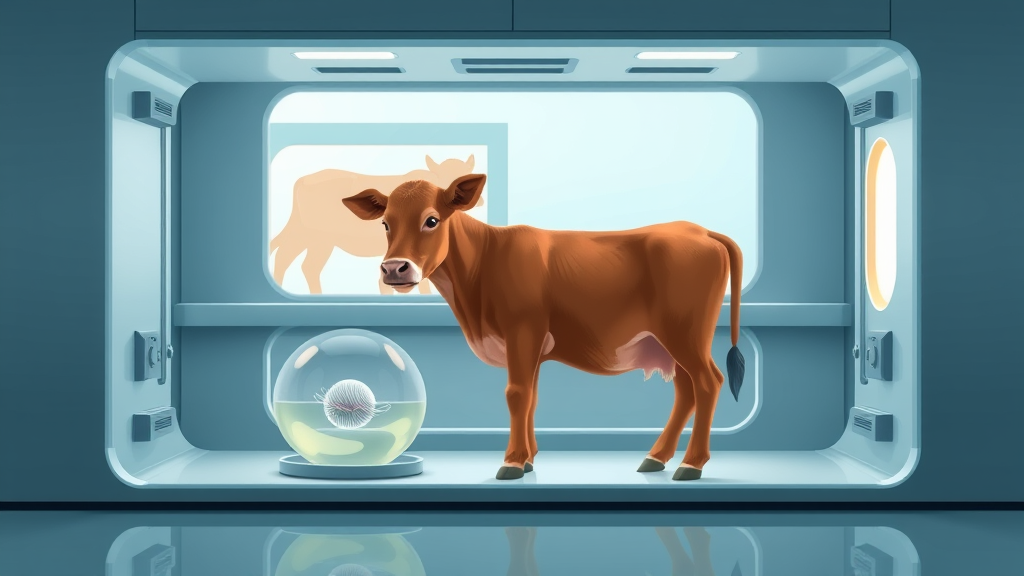

A healthy female Badri calf was born yesterday, September 11, at the Academic Dairy Farm of Pantnagar University in Uttarakhand, and I'll admit this story made me smile all morning. She's the result of in-vitro fertilization work on the breed, a real milestone for a cattle line that doesn't get the attention it deserves. You can read the original report over at Swarajya.
Now, you might wonder why a tech writer is excited about a calf. Fair question. But IVF in livestock is every bit as much a technology story as the phones I usually cover, and in some ways it matters more. Assisted reproduction in cattle has been creeping forward for decades, and each success like this one quietly expands what farmers and scientists can do together.
The Badri breed is indigenous to the Uttarakhand hills, a small, hardy animal adapted to tough mountain terrain. That hardiness is exactly what makes indigenous breeds worth preserving. They resist local diseases, they survive on grazing that would leave a high-maintenance imported breed thin, and they belong to the place in a way factory-favored breeds simply don't. My grandmother kept a couple of cows when I was a girl, and she could tell you more about an animal's constitution from across the yard than any chart could. Some things you learn by living with them.
So what does the science actually involve? In-vitro fertilization means eggs are collected from a donor cow, fertilized with sperm in a lab, and the resulting embryos are implanted in surrogate mothers. It sounds straightforward when I write it in one sentence. It is not. The timing has to be precise down to hours, the embryos are delicate little things, and the success rates in field conditions, as opposed to a polished research setting, have historically been humbling. Getting a healthy live calf out the other end is the whole ballgame, and Pantnagar's team got there.
Why go to all this trouble? Because IVF lets you multiply the genetics of your best animals much faster than natural breeding ever could. A single exceptional cow, instead of producing one calf a year, can contribute embryos to many surrogates at once. For a breed with a small population like the Badri, that acceleration can be the difference between slow decline and real recovery. It's the same logic behind seed banks and heritage crop preservation, just applied to animals. Marcus, my colleague who digs into the technical side of things around here, would probably want to explain the embryo transfer mechanics in full; I'll spare you and just say the underlying biology is genuinely elegant.
And there's a practical payoff beyond conservation. Badri cattle are valued for their milk, which is rich and well suited to the region's dairy traditions. Stronger breeding programs mean better livelihoods for small hill farmers, who don't have the margin to gamble on animals that can't handle the altitude and the weather. Technology should work for you, solving actual problems, and this is one of the clearest examples I've come across in a while. Nobody needed this to be harder than it had to be; the researchers built a tool that fits the need.
I remember when IVF in humans was still considered experimental, something people spoke about in hushed tones. Now it's routine enough that a university dairy farm in the Himalayan foothills can apply the same principles to a local breed, and a healthy heifer arrives on schedule. We take that progress for granted, and we shouldn't.
The team at Pantnagar will presumably continue the program, and I'd expect more calves to follow if the protocols hold up. That's usually how these things go: one success proves the pipeline, then the pipeline proves it can repeat. I'll be watching for news of the next one. In the meantime, welcome to the world, little lady. May you grow up sturdy as the hills you were born in.
Comments (0)
Log in or sign up to join the conversation.
No comments yet. Be the first.