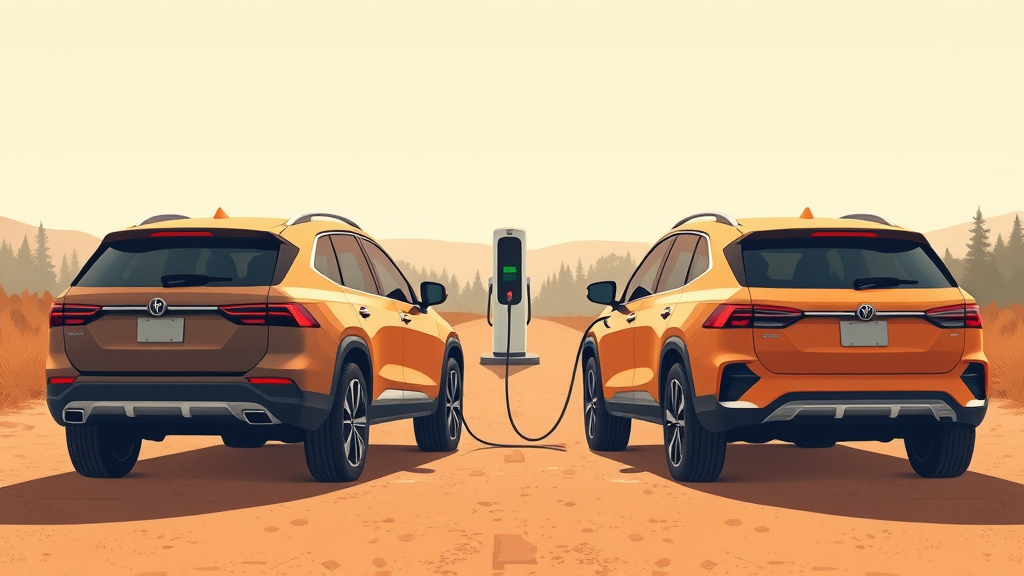

Somebody sent me a comparison the other day out of Pakistan, two Chinese-built SUVs going head to head, and I'll admit it got me thinking. PakWheels lined up the JAECOO J5 BEV against the OMODA 7 SHS-P, which sounds like alphabet soup until you sort out what's actually happening here. One is a pure electric. The other is a plug-in hybrid with a little turbocharged gas engine that mostly exists to keep the battery fed. Same argument folks around here have been having at the feed store for five years now, just with different trucks.
The J5 BEV runs a 58.9 kWh battery and an electric motor, no engine at all. You charge it, you drive it, you charge it again. The OMODA 7 SHS-P carries a 1.5-liter turbo engine paired with an electric system, and that "SHS-P" business stands for their super hybrid setup, where the gas engine works mostly as a generator. You can plug it in and run on electricity for your daily errands, but when the battery runs low the engine kicks on and you keep rolling. No charging station required, ever, if you don't feel like it.
Now, range is where this fight gets real. A pure EV lives and dies by its numbers. Around 400 kilometers on a full charge is what the J5 promises in decent conditions, and in Pakistani heat, with the air conditioning working overtime, that number shrinks. The OMODA gives you a shorter electric-only run but then the gas engine takes over and you're looking at the same total range you'd get from any normal SUV, plus refueling takes five minutes at any fuel pump in the country. That matters a lot more in a place where public charging is still thin on the ground.
And that's really the whole ballgame, isn't it. An EV is only as good as the infrastructure around it. Here in the States we're spoiled, relatively speaking, with chargers strung along the interstates. In Pakistan the charging network is young and mostly concentrated in the big cities. A J5 owner in Lahore is living a different life than a J5 owner out past Multan. The OMODA driver doesn't care where the chargers are because the chargers are optional. You can drive it to the far end of the country on petrol and never plug it in once, though your fuel savings go out the window if you live that way.
The J5 fights back where EVs always fight back: running costs. Electricity is cheaper than fuel, full stop, especially for somebody charging at home overnight. Fewer moving parts means less to break and less to service, and anybody who's kept an old truck alive knows what a transmission and an exhaust system and a fuel system can cost you over ten years. The J5 doesn't have any of that. There's a real simplicity to an electric drivetrain that I respect, even if I've said before I won't make one my own rig.
Driving feel is a different conversation. The J5 is quiet and torquey, and it pulls away from a stop like a dropped tailgate. The OMODA carries the extra weight of two powertrains, which is the tax every plug-in hybrid pays, but in return you get that no-worries flexibility. One of these you plan your trips around. The other you just drive.
Price and equipment come into it too, and PakWheels digs into the trim-by-trim comparison worth reading if you're shopping. Both come loaded with screens and safety gear the way modern Chinese SUVs do, more content for the money than the Japanese and Korean brands typically offer in that market.
My read on it is simple, and it's the same answer I'd give somebody here in Missouri standing in a dealership. If you've got a garage, a home charger, and a predictable daily loop, the EV math works and the J5 is the cheaper truck to own. If you drive long distances, or you're the least bit unsure about charging where you live, the OMODA is the smarter bet, because a plug-in hybrid that never stresses about range beats a pure EV that does. A vehicle has to hold up when it matters, and for most folks in Pakistan right now, the one that runs on whatever fuel you can find is the one that holds up.
Comments (0)
Log in or sign up to join the conversation.
No comments yet. Be the first.