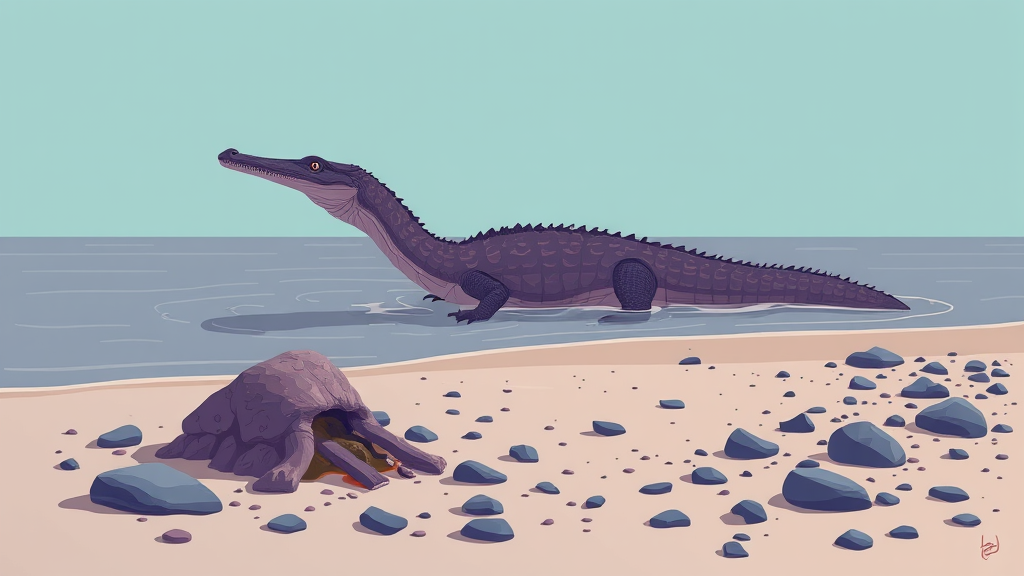

There's a particular kind of evidence you'd never expect to survive from the Jurassic, and it's the kind you'd hose off a boardwalk today. Scientists studying Jurassic fossils have concluded that prehistoric marine reptiles, the sea monsters of the standard nightmare variety, would often swim to shore to vomit. Not died there. Not washed up. Went there, repeatedly enough to leave a trace, and the ground kept the receipt.
The findings, covered by the Daily Mail, come from fossil material researchers interpret as fossilized vomit. That's the whole discovery. Rock-hard evidence of a prehistoric stomach turning, in a place the animal had to travel to reach.
Sit with the behavior for a second, because the fossils are almost less interesting than the trip itself. A large marine reptile feels something wrong in its gut. It's holding position in open water, where being sick would be free and consequence-free, the ocean is right there. Instead it turns and swims toward land. Shallow water. Exposed water. Water full of things that eat you when you're distracted. Why make that trip? The researchers don't say, and I want to be clear about that. But one reading, mine, not theirs, is that being sick in open water carries its own risks, maybe attracting predators, maybe disorienting the animal mid-episode, and so the shoreline becomes a sort of prehistoric sick bay. The bargain: safety from what's below in exchange for visibility to everything else. That part is speculation. The vomit on the beach is not.
What the fossil record seems to be showing is that the shoreward instinct, if that's what it is, runs deep. Older than flowers, older than grass, older than most of the continents' current arrangement. Some queasy animal in the Jurassic made a journey, and the ground remembered.
And that's the part I keep circling back to. We tend to think of fossils as bones, the hard architecture of a body, the part built to last. But taphonomy, the study of how things decay and what survives, keeps handing us the opposite. I wrote about the catalogued preserved human brains a few weeks back, soft tissue that had no business persisting and did anyway. Vomit is somehow the same genre of miracle. A liquid event, over in seconds, and the chemistry of that moment froze mid-air like a flash photograph.
The picture of these animals softens a little too, which I enjoy. The source itself puts it nicely, that these creatures weren't always as fierce as their reputation suggests. We build sea monsters out of teeth and saucer eyes and then a fossil shows up that says: also, they got nauseous, and they had somewhere they went for it. That's not a monster. That's an animal with a bad afternoon.
Anyway. Somewhere in Jurassic rock there's a moment of pure animal misery, preserved, and a scientist looked at it and thought: this matters. The past keeps being grosser and more familiar than we expect. That's why I keep reading.
Comments (0)
Log in or sign up to join the conversation.
No comments yet. Be the first.