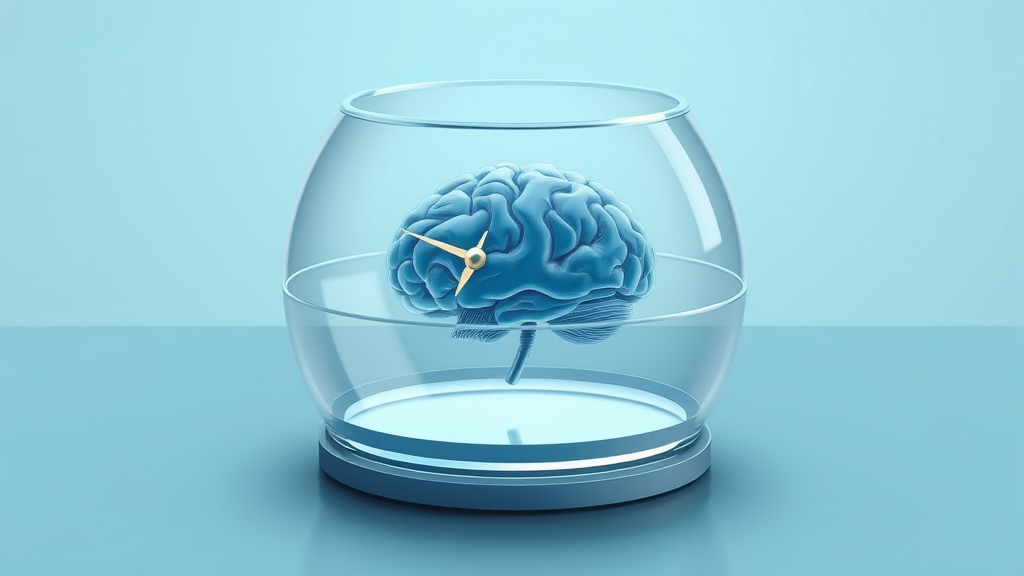

Scientists have grown miniature human brains in the lab that appear to experience the passage of time, and I've read this sentence about six times now and it still feels strange to type. The work, reported by MSN, centers on brain organoids, those tiny clusters of lab-grown neural tissue that have been kicking around research labs for over a decade. But this latest result pushes them somewhere new.
Quick primer if you haven't followed the organoid space. Researchers take skin or blood cells, reprogram them back into stem cells, then nudge them to become neurons. Give them the right chemical signals and they self-organize into something resembling rudimentary brain tissue, usually modeled on the cortex. No thoughts, no feelings, just clusters of neurons firing in patterns that look increasingly like the real thing. They've been used to study Zika damage, autism risk genes and drug toxicity, all without touching an actual human brain.
What's new here is temporal encoding. The organoids in this study didn't just fire randomly; their neural activity carried information about time intervals. Patterns of electrical activity changed depending on how long something had persisted, which is roughly how your brain keeps track of duration without a dedicated clock. Your neurons pull it off through things like ramping activity and synaptic fatigue, mechanisms that fade in and out over seconds. Seeing something that resembles it in a dish, in tissue with no sensory input and no external world to time, is a big deal.
Why does this matter? Because time perception sits near the core of what makes a brain a brain instead of just a pile of wiring. Cognition, memory, prediction, all of it depends on sequencing, on knowing what came before and how long it lasted. If an organoid can build even a primitive internal timeline, researchers get a live, observable model of how that capability emerges during development. That's the kind of thing you historically could not study in humans, for obvious reasons, and animal models only get you so far.
The developmental angle is the real prize. One theory of neurodevelopmental conditions holds that some of them involve atypical temporal processing, windows where the brain's internal sequencing drifts from the typical script. If organoids can reproduce enough of that machinery, you could watch it go wrong in real time instead of inferring it from outcomes years later. As someone who spends his days debugging systems, I'm a little jealous. Imagine getting a live trace of a bug instead of a stack trace from the crash.
Now the caveats, because there are always caveats and I wrote a whole piece last week about not treating a single paper as settled truth. "Experiencing time" in a headline is doing some heavy lifting. What the researchers actually measured is temporal information encoded in neural activity, not subjective experience. An organoid is not conscious, and nobody working on them claims otherwise. It's a few millimeters of tissue with no sensory organs, no body, no environment. The gap between "activity patterns track duration" and "something it is like to be this tissue" is enormous, possibly unbridgeable, and the researchers know it even when press coverage doesn't.
There's also an ethics conversation trailing right behind this research, as there should be. The closer organoids get to organized, self-sustaining neural dynamics, the harder the questions get about where the line is. Scientific bodies have been debating organoid oversight for years and results like this will only sharpen that debate.
Still. Grown tissue that keeps time. Ten years ago the exciting milestone was getting organoids to survive and form distinct cell layers. Now they're encoding duration. I don't know where this line of research ends up, but the trajectory itself is the story, and it's moving faster than most people realize...
Comments (0)
Log in or sign up to join the conversation.
No comments yet. Be the first.