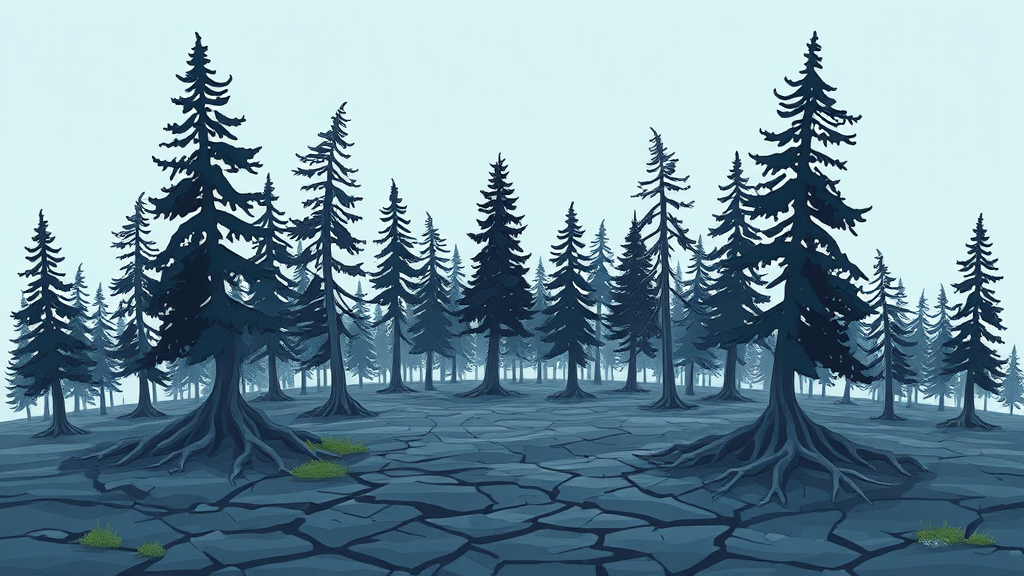

I've spent my whole career paying attention to the signals our gadgets give us. Low battery chimes, spinning wheels, that little dot that says your smart lock is doing exactly what it should. But nature sends signals too, and some of the most striking ones are coming out of Canada's north right now. They call them "drunken forests," and once you've seen a photo, you never forget it.
The trees look like they've had a few too many. Birches and spruces leaning every which way, crowding against each other like guests at the end of a very long party. It would almost be funny if the cause weren't so serious. As SooToday explains, these tipsy trees are one of the clearest visible signs that the permafrost beneath them is thawing.
Permafrost, for those who didn't grow up geology-obsessed like a certain kid I once knew, is ground that stays frozen year-round, and in some places it has been frozen for thousands of years. It underlies a huge portion of Canada's north. When the ground above it thaws seasonally, that's normal. But when the frozen layer itself starts to soften, the soil turns mushy and starts to slide and slump. Trees rooted in that shifting ground lose their footing. They tilt, they lean, sometimes they simply lie down.
The title of the piece says it plainly: these forests teach us how to see what's happening underground by looking at what's above it. A forest full of leaning trees is a forest standing on ground that has started to move. You don't need a sensor or a satellite pass to spot it. The trees are the indicator.
Why does this matter beyond the trees themselves? Because permafrost holds an enormous amount of organic matter, frozen in cold storage for millennia. When it thaws, that material starts to decompose and release greenhouse gases. Thawing ground also destabilizes everything built on top of it: roads, pipelines, buildings, entire communities in the north. What looks like a curiosities-of-nature photo is really a progress report on changes that affect infrastructure and people's homes.
I remember when the first climate data dashboards started appearing online, and everyone assumed the story would come from sensors and satellites. Some of it does. But some of the clearest evidence is standing right there in the forest, leaning at an angle, patient and undeniable. I love my shiny instruments as much as the next person, and yet sometimes the ground itself, quite literally, is the instrument.
The core principle is the same one I apply to any technology worth having. Information is only useful if it helps someone make a better decision. A visible sign of thawing ground is exactly that kind of information, and the people who live on this land deserve to have it.
If you get a chance, go look at some photographs of a drunken forest. My granddaughter Jess looked over my shoulder at one the other day and asked why the trees were dancing. I didn't have a cheerful answer for her. But she'll grow up in a world where these forests keep talking, and the least we can do is listen to what they're telling us.
Comments (0)
Log in or sign up to join the conversation.
No comments yet. Be the first.