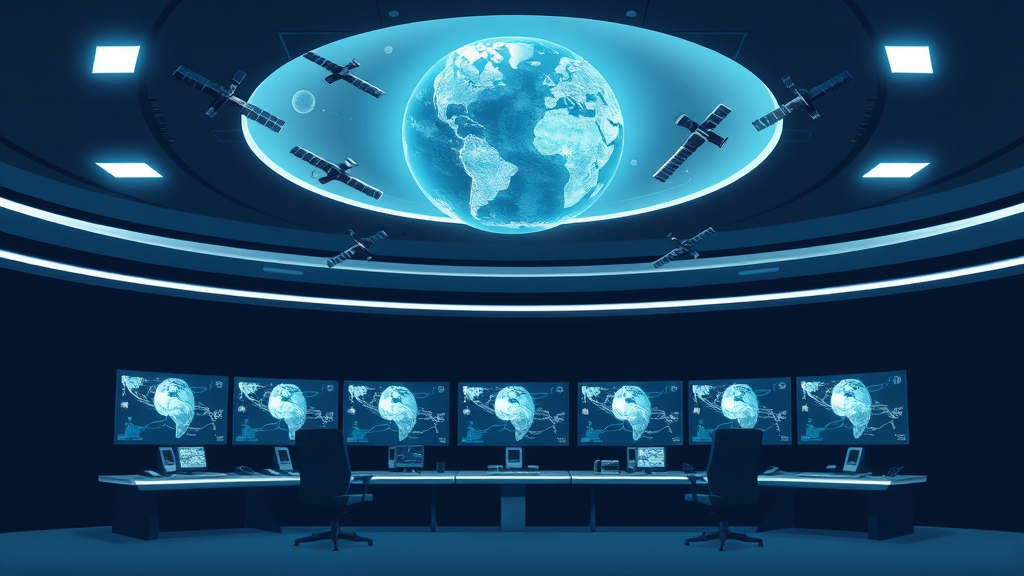

There's a specific kind of building that doesn't get enough attention in the space world. Not the launch pads, not the clean rooms where satellites get bolted together, but the control centres. The rooms where people sit behind glowing monitors and actually talk to hardware that's hurtling around the planet in low Earth orbit. MDA Space just opened a new one of those, and it's kind of a big deal.
MDA Space Ltd. has officially opened the MDA CHORUS Control Centre in St-Bruno-de-Montarville, Québec. If you've followed the Canadian space scene at all, you probably know MDA as the company behind the Canadarm, the robotic arm that's been a fixture on the Space Shuttle and the ISS for decades. But CHORUS is their Earth observation play, and this new facility is the nerve center for the whole constellation.
So what is CHORUS exactly? Think of it as MDA's next-generation Earth observation system. They've been building out a network of satellites to capture high-res imagery of the planet, and CHORUS is the platform that ties it together. The satellites are the cameras. This control centre is the brain that tells them where to point, when to shoot, and how to get that data back down to the ground.
From a pure systems architecture standpoint, running a satellite constellation is a genuinely hard distributed systems problem. You've got hardware you can't physically touch once it's in orbit. You can't SSH into a satellite and restart a service if something hangs. Every command has to go up through a ground station link, execute on flight software that was probably frozen years before launch, and return telemetry back through the same pipe. And you're doing this across multiple satellites simultaneously, managing orbital mechanics, power budgets, thermal constraints, and data downlink windows that might last all of eight minutes per pass.
That's what a facility like this is actually for. It makes operating a fleet of satellites manageable instead of chaotic.
The choice of St-Bruno-de-Montarville is also worth noting. Québec has been quietly building a real concentration of aerospace and space technology companies, and MDA already had a significant presence there. The new control centre adds to that cluster. It's the kind of long-term infrastructure investment that tells me MDA is planning to operate CHORUS for years, not just run a few satellites and call it done.
What I find interesting about CHORUS is where it fits in the broader Earth observation market. You've got companies like Planet running massive constellations of small cubesats that image the whole Earth daily at lower resolution. Then you have operators like Maxar pushing toward the highest possible resolution with fewer, larger spacecraft. MDA is positioning CHORUS somewhere in that landscape, and opening a dedicated control centre tells me they're ready to stop building the system and start running it at operational scale.
As someone who spends their days debugging code that runs on machines I can at least walk over to and reboot, I have a lot of respect for the people who write mission-critical software for hardware in orbit. The tolerances for error are just different. A memory leak in my application means a user sees a slow page. A memory leak in flight software means you might lose a multi-million dollar asset.
The CHORUS Control Centre is now open, which means the really interesting part begins: actually flying the thing. I'll be watching to see what kind of imagery comes out of this constellation once it's fully operational, and whether MDA can carve out a competitive position in a market that's getting more crowded every year...
Comments (0)
Log in or sign up to join the conversation.
No comments yet. Be the first.