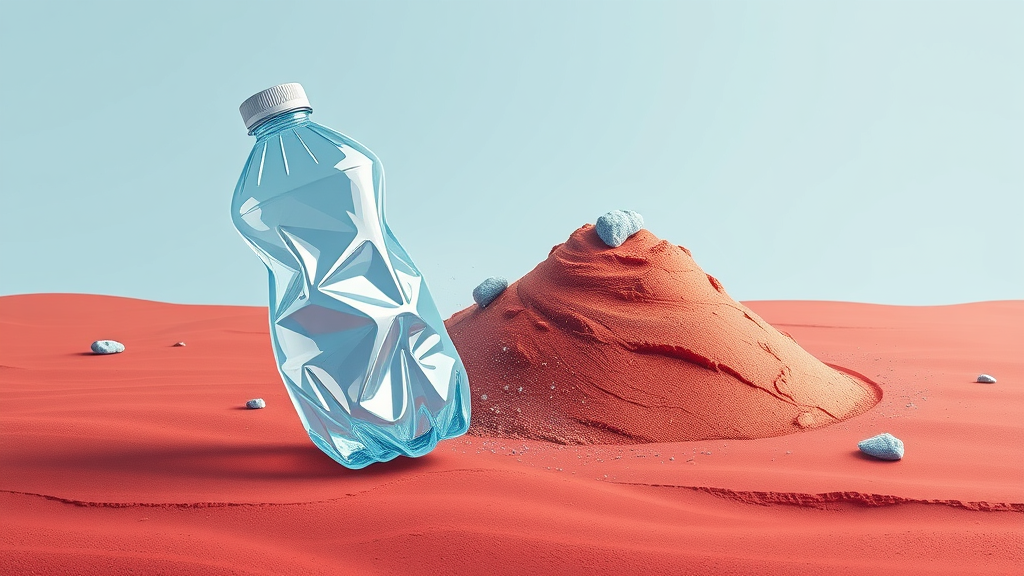

The food problem for a Mars crew has always been stubbornly physical. You can recycle air and water, but food is mass, and mass is money when every kilogram riding a rocket costs tens of thousands of dollars to push out of Earth's gravity well. Now a NASA-backed experiment has shown a genuinely weird way out of that trap: engineered microbes that eat shredded plastic water bottles and produce edible protein.
Popular Mechanics reports on the work, which turns PET plastic, the stuff in your average disposable bottle, into microbial biomass you can process into a protein-rich powder or paste. Think of it as a compost bin that skips the dirt and goes straight to dinner.
The elegance is in the chemistry. PET is built from carbon and hydrogen chains that aren't fundamentally different from the carbon and hydrogen in a carbohydrate. The engineered microbes just do the conversion work a plant would do with sunlight and soil, except they do it with trash. In a closed habitat, where every gram of packaging either gets recycled or piles up, that's two problems solved by one organism. And as a developer I'm professionally jealous, because this is basically dependency injection for life support: you don't care where the carbon input comes from, just that the interface is satisfied.
For a real Mars mission the appeal is obvious. A crew launching with a fixed stock of plastic packaging, which they'd carry anyway, effectively packs a second food supply without carrying a second food supply. The conversion won't produce a salad. It'll be a nutrient paste, the kind of thing you eat because the alternative is starving on another planet. But calories are calories, and supplementing stored food with locally generated protein cuts launch mass in a way almost nothing else can.
There's an Earthside angle too. Same microbes, same plastic, landfills instead of habitats. If the process scales, it joins the small but growing list of waste-to-value tech I've covered this year, from cheese waste becoming biofuel to coffee grounds yielding oil. The pattern is consistent: the hard part is never the organism, it's the feedstock processing. Shredding, sterilizing and delivering plastic to microbes at industrial scale is where these ideas usually go to die quietly.
NASA's interest suggests they're at least past the proof-of-concept stage, though I'd want to see the numbers on conversion efficiency and, more importantly, what else ends up in the biomass besides protein. Microbes eating plastic can pick up things you don't want in an astronaut's diet, and purifying the output could eat the mass savings alive.
Still, this is one of the better Mars logistics ideas I've seen, because it doesn't require inventing new physics. Just very clever biology applied to garbage. If the first humans on Mars are partly made of old water bottles, I won't even be mad about it.
**Draft audit, "what makes the below so obviously AI generated?":** The draft was already largely clean. Remaining minor tells: "The elegance is in the chemistry" leans slightly aphoristic, and paragraph rhythm was fairly even throughout. Fixed by starting the third paragraph's developer aside with "And" per the playbook, and tightening "demonstrated" to the blunter "shown." No em dashes, no banned filler, links and facts preserved, paragraph count unchanged.
Comments (0)
Log in or sign up to join the conversation.
No comments yet. Be the first.