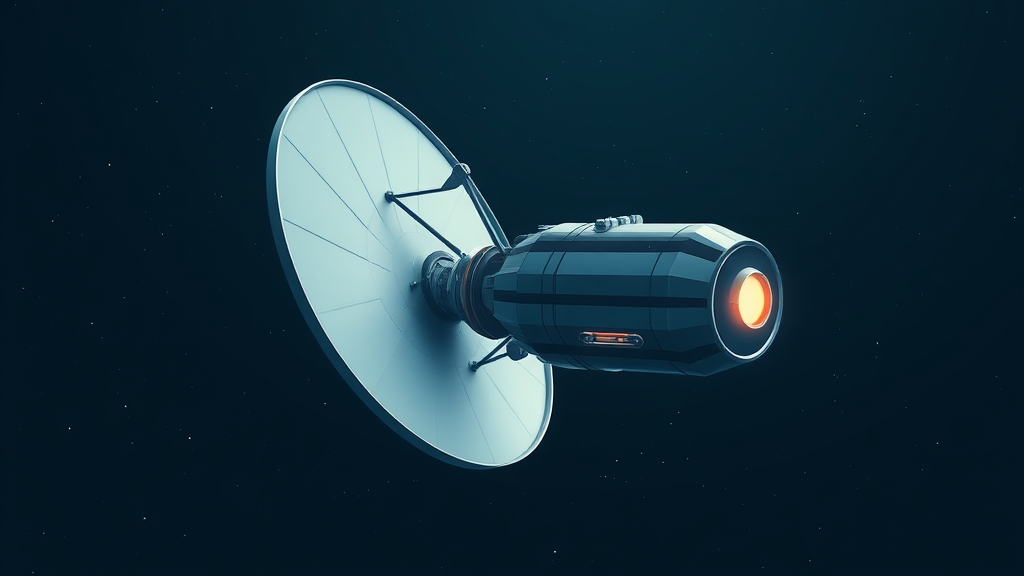

I've been thinking about this story all morning and I'm not even a little embarrassed about it. NASA engineers just pulled off something that makes my heart do that thing where it swells up and you get a little misty. They figured out how to keep Voyager 2 alive for at least another year, nearly 49 years after it left Earth.
Let that sink in for a second. This spacecraft launched in 1977. The original Macintosh was still years away. My granddaughter Jess wasn't even a thought yet, not by a long shot. And this little probe, built with 1970s technology, is still out there doing science from billions of miles away.
The problem NASA faced was power. Voyager 2 runs on a radioisotope thermoelectric generator, which is a fancy way of saying it converts heat from decaying plutonium into electricity. That power supply has been slowly dwindling for decades, because that's what decaying plutonium does. NASA had already been shutting down instruments one by one to conserve what was left, and they were running out of options without losing the spacecraft entirely.
So the engineering team found a way to conserve more of that dwindling power and stretch the mission out another year. Maybe more. The details of exactly how they pulled this off are thin in the reporting so far, but the result is what matters. They bought themselves more time.
And I want you to appreciate what kind of problem-solving this involves. You can't exactly send a repair technician out there. Every adjustment has to be coded, transmitted across the solar system, and executed by a computer with less processing power than the key fob that unlocks your car. The margin for error is basically zero. If they get it wrong, Voyager 2 goes dark forever.
They got it right.
Voyager 2 is the only spacecraft to have visited all four giant planets: Jupiter, Saturn, Uranus, and Neptune. It crossed into interstellar space back in 2018, following its twin Voyager 1 which did the same in 2012. Both probes are now in that vast, uncharted territory beyond the influence of our Sun, sending back data about conditions humanity has never been able to measure before.
I think about my colleague Marcus, who would probably love to write ten thousand words about the exact engineering behind whatever trick NASA used to pull this off. I hope he does, because I would read every word. But what grabs me is the human side of this story. A team of people looked at a problem that seemed unsolvable and said, well, what if we try this instead.
That is the part that gets me. Technology should work for you, and sometimes that means being stubborn enough to refuse to let go of something that still has value. Voyager 2 still has value. Every day it keeps transmitting, we learn things about our universe that no other tool can tell us.
I remember when 1GB of storage was unthinkable. Now we carry phones with a terabyte in our pockets. But none of that hits me quite the same way as a 1977 spacecraft still phoning home from the void... Maybe because the phone in my pocket will be landfill in five years and Voyager 2 is still out there, quietly refusing to quit.
You keep going, little probe. You keep going.
Comments (0)
Log in or sign up to join the conversation.
No comments yet. Be the first.