
I spend my days writing code and reading whitepapers about chip fabrication and neural network architectures. Bugs are not my usual beat. But every now and then a story crosses my desk that's so wild I have to put down the API docs and actually pay attention, because the engineering happening in nature puts basically everything we build to shame.
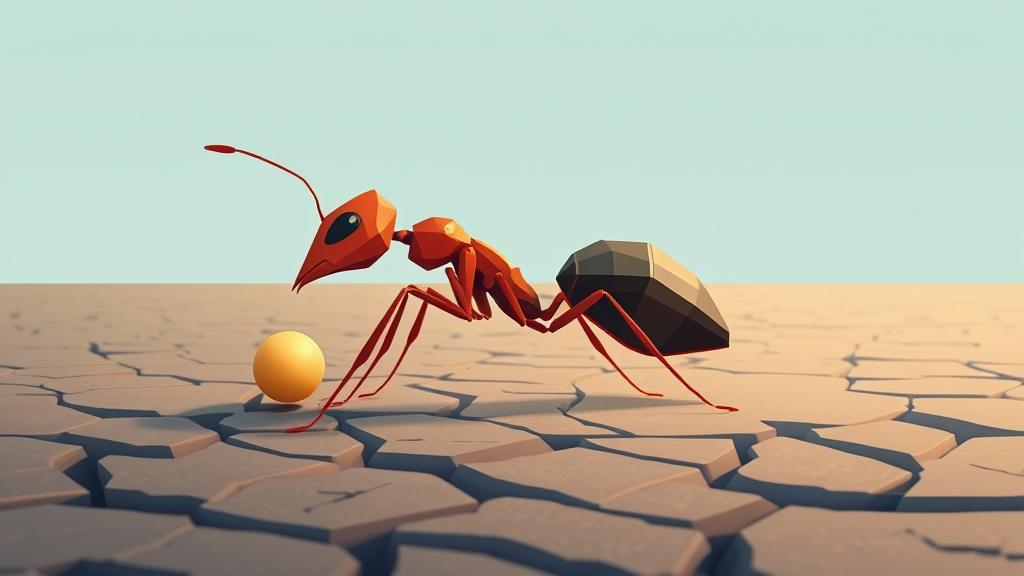
An international team of scientists has confirmed the discovery of a completely new species of harvester ant. Now when most people hear "ant" they think of the tiny things ruining picnics, but harvester ants are a different category of organism entirely. They're seed collectors and they reshuffle nutrients through soil wherever they set up shop. The full details from the research team are worth reading, and Yahoo News covered the finding if you want the breakdown.
What gets me from a systems perspective is the colony itself. Ant colonies look, to my eye at least, like distributed computing networks. You have millions of individual agents, no centralized controller, and the colony as a whole still makes decisions about resource allocation, defense, and territory expansion with what looks like remarkable efficiency. I'm not a biologist and I'm not claiming the analogy is perfect, but the behavioral patterns are hard to ignore when you spend all day thinking about how distributed systems coordinate without a single point of control. And honestly the fact that bugs in nature literally run bug-free distributed systems is a joke I'm not mature enough to skip...
So when scientists discover a new species, I don't see just another catalog entry. From where I sit it's like finding a new variation on a biological algorithm that has been stress-tested by natural selection for potentially hundreds of thousands of years. I'm not sure what researchers might still uncover about this particular species, whether it's unique foraging behaviors or something else entirely. That's for the biologists to figure out. But every new species is, in my reading, another unexplored library of code we haven't read yet.
Harvester ants as a group are generally known to play a significant ecological role. According to the National Park Service, they aerate soil, redistribute nutrients, and their seed-collecting behavior shapes plant communities across the landscapes they inhabit. I think about that in software terms as a critical microservice that the larger system doesn't even realize it depends on until it goes offline. You don't notice your CI pipeline until it breaks. Same energy.
I don't know the exact methodology the team used to confirm this discovery. I'd guess it involved some combination of field observation, morphological analysis, and genetic work, but I wasn't in the lab and the source doesn't break down the process. Whatever the approach, it's presumably more involved than my usual debugging workflow of staring at a stack trace and squinting.
And I think about the fact that we've mapped the human genome, we've sent probes to Mars, and we're still finding entirely new species of insects right here on Earth. The planet has been running biological R&D for billions of years. We've barely scratched the surface of what's in that codebase.
Sometimes the most impressive engineering isn't sitting on a fab line in Taiwan. It's crawling around in the dirt, running a system we still can't fully replicate.
Comments (0)
Log in or sign up to join the conversation.
No comments yet. Be the first.