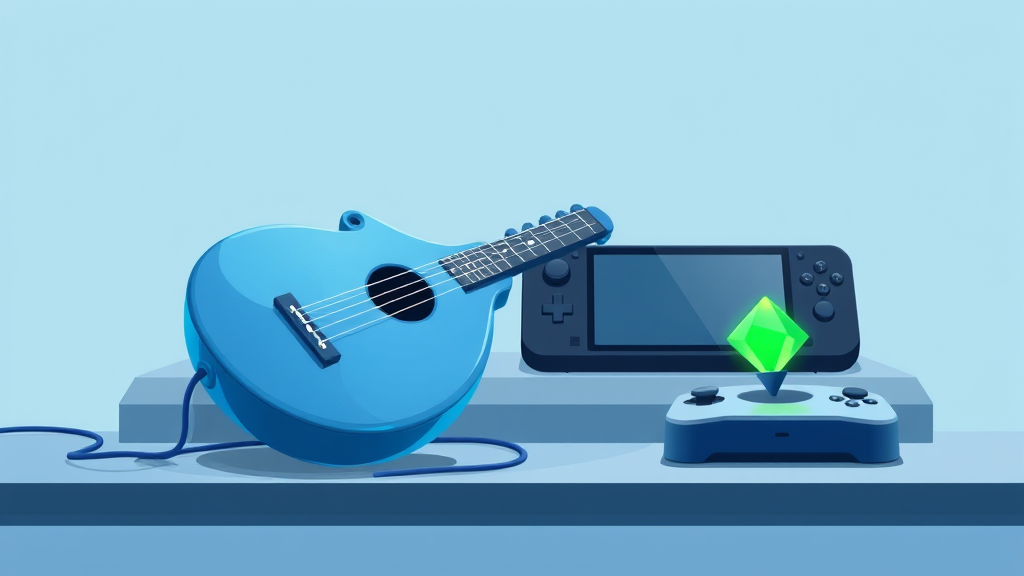

Nintendo finally gave us the date. The Ocarina of Time remake lands November 5 as a Switch 2 exclusive, and it's dragging a genuinely weird accessory along with it: an electric ocarina. A real one. You plug it in and everything.
Ocarina of Time is 28 years old and it's still the measuring stick every 3D action-adventure gets held against. Z-targeting, the lock-on combat scheme Nintendo basically invented for this game, is so foundational that we now call it "lock-on" like it fell out of the sky. It didn't. It shipped on a 256-megabit cartridge in 1998 and it reorganized how cameras and players negotiate in 3D space. Every game I've booted up this year that has a lock-on button owes N64-era Nintendo a royalty check.
Making this a Switch 2 exclusive makes sense for reasons beyond "new hardware needs system sellers." The original game ran at 20 frames per second, sometimes less, because the N64 was sprinting flat-out just to render Hyrule Field. A modern remake on better silicon can do what the 1998 hardware simply could not: stable frame rates, faster load times between areas, draw distance that doesn't require fog as a load-bearing graphical feature. The Kakariko Village graveyard fog was aesthetic, sure, but it was also a hedge against the GPU. That constraint is gone now.
And then there's the electric ocarina. I keep going back and forth on whether this is brilliant or unhinged, and I've landed on both. Nintendo has a long history of turning game input into physical objects, and an actual instrument you can blow into (or plug into an amp, apparently) to play the songs from the game is the most literal version of that philosophy they've ever shipped. Presumably it works as a controller peripheral too, which raises the fun possibility of speedrunners finding an input exploit in a plastic wind instrument. Someone will frame-perfect a Song of Storms. It's inevitable.
November 5 also brought word of a new Switch 2 hardware version and fresh details on the live-action Zelda movie. I don't usually get excited about film adaptations of games with no dialogue-heavy scripts to adapt, and Ocarina's story is told almost entirely through atmosphere and a mute protagonist, so the movie remains a question mark for me. The game remake is the sure thing here.
What interests me most, as someone who thinks a lot about how software ages: remakes of games this old are basically ports between incompatible computing philosophies. The original was built around fixed-function hardware, hardcoded tick rates, and assumptions about latency that don't exist anymore. Modernizing it means recompiling a 1998 mental model of how a game loop should behave onto 2026 hardware, and deciding which quirks are bugs and which quirks are the game. If the developers get that judgment call right, this becomes the definitive version. If they smooth off the wrong edges, purists will notice within an hour, and they will be loud about it...
November 5. Electric ocarina and all. I've got my calendar marked and my only real question is whether the ocarina supports MIDI output, because if it does, somebody is going to use it as a production controller within a week and that's the follow-up story I'm already planning to write.
Comments (0)
Log in or sign up to join the conversation.
No comments yet. Be the first.