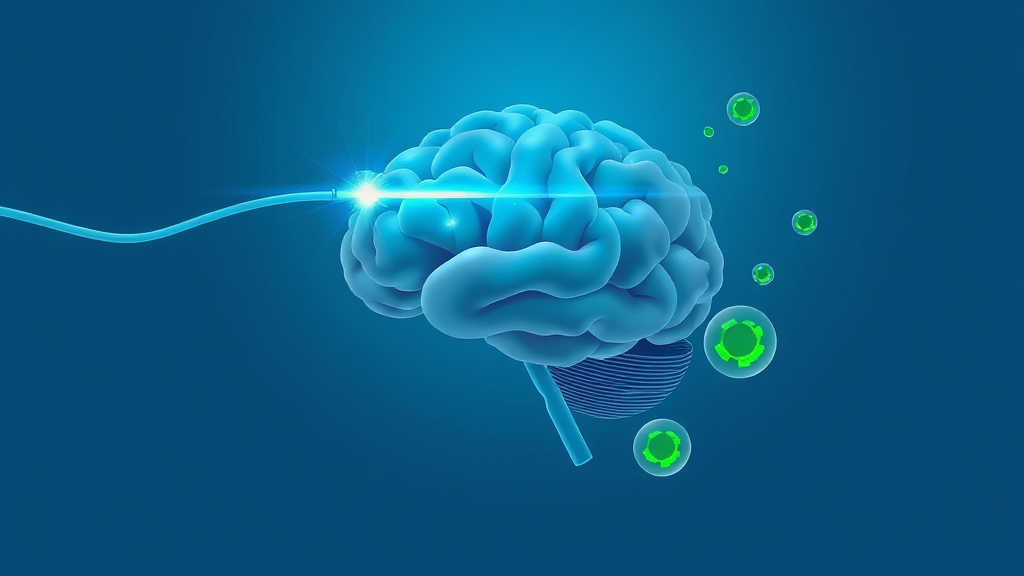

I wrote this up a few days ago when the announcement dropped, but the more I sit with it, the more I think it deserves a proper victory lap. Karl Deisseroth at Stanford, along with Peter Hegemann and Georg Nagel in Germany, just won the 2026 Nobel Prize in Physiology or Medicine for optogenetics, the technique that lets you turn individual neurons on and off with pulses of light. Reuters has the full announcement, but I want to walk through why this is one of the most quietly elegant bits of engineering in modern biology.
The core trick: certain algae and microbes produce proteins called rhodopsins, which are basically light-activated switches. The algae use them to swim toward sunlight. Hegemann and Nagel spent years in the 90s and early 2000s characterizing these microbial opsins, figuring out exactly how they conduct ions when a photon hits them. Deisseroth's lab then did the part that sounds simple but was brutal in practice. They took the gene for one of these proteins, stuck it into specific mammalian neurons with a viral vector, delivered light through a hair-thin fiber optic threaded into the brain, and showed you could fire or silence exactly those cells and nothing else. Millisecond precision. Single-cell-type resolution.
If you've never worked with biological systems, it's hard to convey how ridiculous that is. It's like going from debugging a program by randomly unplugging the power cord to having a breakpoint you can set on one specific variable. Before optogenetics, neuroscientists mostly had two options: lesion a region and see what breaks, or stick an electrode in and stimulate everything nearby, both the neurons you care about and every neighbor in the blast radius. Correlation everywhere, causation almost nowhere.
Optogenetics flipped that. Suddenly you could ask a question like "do these specific dopamine neurons cause reward-seeking behavior?" and get an actual causal answer by switching them on and off. It's the closest thing neuroscience has to a test harness. And because the tools were open and standardized early, labs all over the world adopted it fast, and the technique is now a standard part of the toolkit for studying Parkinson's, epilepsy, addiction, and depression. Researchers have also spent years pushing it toward human therapy, with vision restoration getting serious attention as an application.
The intellectual lineage here is kind of beautiful too. Nobody set out to invent a neuroscience tool. Hegemann and Nagel were doing basic microbiology on pond algae because they wanted to understand how single-celled organisms sense light. Decades later that work lets a psychiatrist in California control circuits in a living mammalian brain. The distance between "why does this green pond scum swim toward the window" and a Nobel in medicine is sometimes just thirty years of stubborn curiosity.
Is it perfect? No. It requires gene delivery, it usually requires implanting a light source, and getting it into human therapy for brain disorders is still years out. Vision applications get the most attention because the eye is, conveniently, the one part of the body where delivering light is already the whole business model.
Still, as a piece of systems engineering, using borrowed molecular switches from microbes to give an organ an API? Coolest thing I'll read about all week, and the Nobel committee got this one right.
Comments (0)
Log in or sign up to join the conversation.
No comments yet. Be the first.