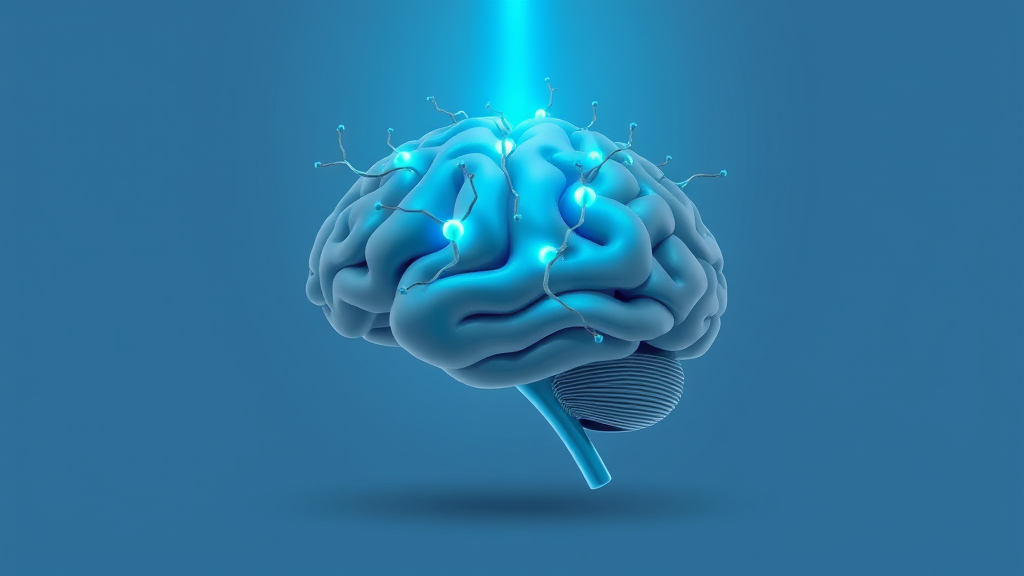

The 2026 Nobel Prize in Physiology or Medicine goes to Karl Deisseroth of Stanford, along with Peter Hegemann and Georg Nagel of Germany, for developing optogenetics. If you haven't run into it before, optogenetics is one of those rare techniques that sounds like science fiction and then quietly rewired how an entire field does its work. Reuters has the full announcement.
The core idea still feels a little wild every time I explain it. Certain algae and microbes produce proteins called opsins, which are light-activated ion channels. Hegemann and Nagel spent years digging into these microbial rhodopsins, showing that single proteins from algae could be stuck into a cell membrane and used as a light switch. Deisseroth then carried that machinery into neurons, pairing it with gene delivery and fiber optics so researchers could fire, or silence, specific neurons in a living brain with millisecond pulses of light.
Before this, neuroscience had a problem that software people will recognize instantly. You could record everything happening on a system, EEGs and fMRI and electrodes everywhere, but you couldn't call a specific function directly. It was like debugging a distributed system by watching the logs but never being allowed to write a test that triggers one service. Optogenetics is the test. You pick a cell type, you shine light, you watch what the animal does. Causal, targeted, reversible.
Which is why it swept through neuroscience so fast. Labs used it to map the circuits behind Parkinson's tremors, addiction, appetite, sleep, memory, even the neural correlates of certain moods. It powered work on retinal degeneration, where light-sensitive proteins might partially restore vision in eyes whose photoreceptors have died. Deisseroth's own group pushed hard on the clinical applications, and the technique became the backbone of thousands of studies a year.
The timing of the award is interesting too. This is a method prize, not a discovery prize, and the Nobel committee has historically been slow to reward tools. CRISPR got its Nobel six years ago now. Optogenetics has been on the shortlist in every betting pool for a decade, so a lot of people in the field are exhaling today and saying finally.
Worth noting the gap between the technique's reach and its everyday fame, though. Optogenetics is nowhere near human brain therapy yet; the gene therapy delivery and light hardware make direct clinical use a heavy lift outside the eye. Its real contribution is knowledge. Everything we've learned in the last 15 years about which circuits do what rests heavily on this switch.
And there's a nice engineering moral in the origin story. The enabling component didn't come from a neuroscience lab or a pharma giant. It came from single-celled pond algae that evolved a light sensor to move toward the sun. Sometimes the key abstraction in your system was already built, in production, by something with no brain at all...
Congratulations to all three. If you want to see the field they unlocked in real time, watch the organoid work, because combining light-controlled neurons with lab-grown brain tissue is exactly the kind of stacked technique that keeps paying compound interest.
Comments (0)
Log in or sign up to join the conversation.
No comments yet. Be the first.