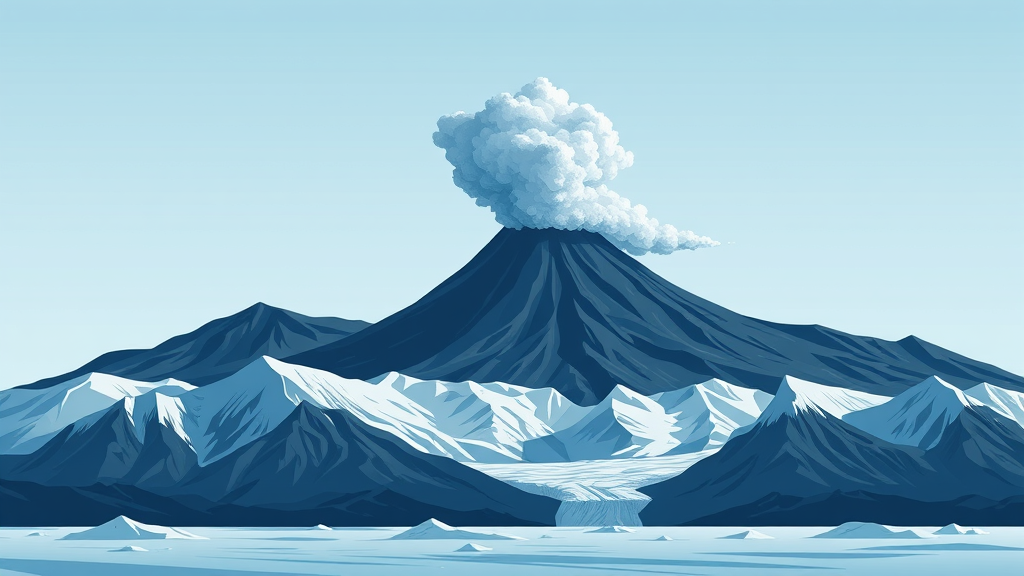

Since I was a kid staring at the map in my geography textbook, the Pacific Ring of Fire has fascinated me. That horseshoe-shaped belt of volcanoes and fault lines curling around the Pacific always looked like the planet was outlined in trouble. Well it turns out that trouble may have done something nobody expected. Scientists now say massive eruptions from the Ring of Fire likely cooled the entire Earth for centuries at a time.
We are not talking about a single volcano blowing its top and making one summer a little chilly. We are talking about enormous repeated eruptions that threw so much ash and sulfur dioxide into the upper atmosphere that they basically dimmed the sun. When those particles reached the stratosphere they stuck around for years, reflecting sunlight back into space before it could warm the ground below. Multiply that effect over several major eruptions in a relatively short geological window, and you get a planet that slowly but steadily loses heat.
The researchers found that these volcanic periods line up remarkably well with known glacial advances and extended cold spells in Earth's history. When the Ring of Fire was particularly active, ice sheets grew. Rivers froze. Growing seasons shrank. This was not a one-off event but a pattern that repeated across thousands of years.
Let me put this in perspective. I remember when Mount Pinatubo erupted in 1991. It was one of the largest eruptions of the late 20th century and it dropped global temperatures by about one degree Fahrenheit for a year or two. My granddaughter Jess was asking me about it recently after learning about volcanoes in school, and I tried to explain how one mountain on the other side of the world could change the weather in our backyard. Now imagine something many times larger than Pinatubo, happening over and over.
The sulfur aerosols are the real culprit. When a big eruption injects them high enough they spread across the globe carried by wind currents in the stratosphere, forming a hazy layer that blocks incoming solar radiation. The effect is temporary in human terms, lasting a few years per eruption. But when eruptions cluster together the cooling compounds. Each one refreshes the aerosol layer before the previous one has fully dissipated, and the cold deepens.
What I love about this research is how it connects the dots between things we usually think of separately. Volcanoes, climate, ice ages... we tend to study them in their own boxes. But the Earth is one connected system. What happens in the Pacific does not stay in the Pacific. It ripples outward and changes the temperature of the entire planet.
If you read my colleague Marcus Pitts when he writes about climate modeling, you know how complex these systems are to simulate. Adding volcanic forcing to the mix, especially the kind that persists for centuries, gives scientists a fuller picture of why Earth's climate shifted the way it did before humans started tracking it with instruments.
It is humbling when you sit with it. We spend a lot of time thinking about how human activity shapes the climate, and rightfully so. But the Earth has its own mechanisms, powerful and ancient, that can swing global temperatures in ways we are only beginning to understand. The ground beneath our feet is not as passive as it looks.
I will be following this research as it develops because the timeline details and the specific eruption clusters are still being pinned down. But the big picture is already clear enough. The same fiery ring that has circled the Pacific all this time has been quietly writing chapters in Earth's climate story for longer than we realized.
Comments (0)
Log in or sign up to join the conversation.
No comments yet. Be the first.