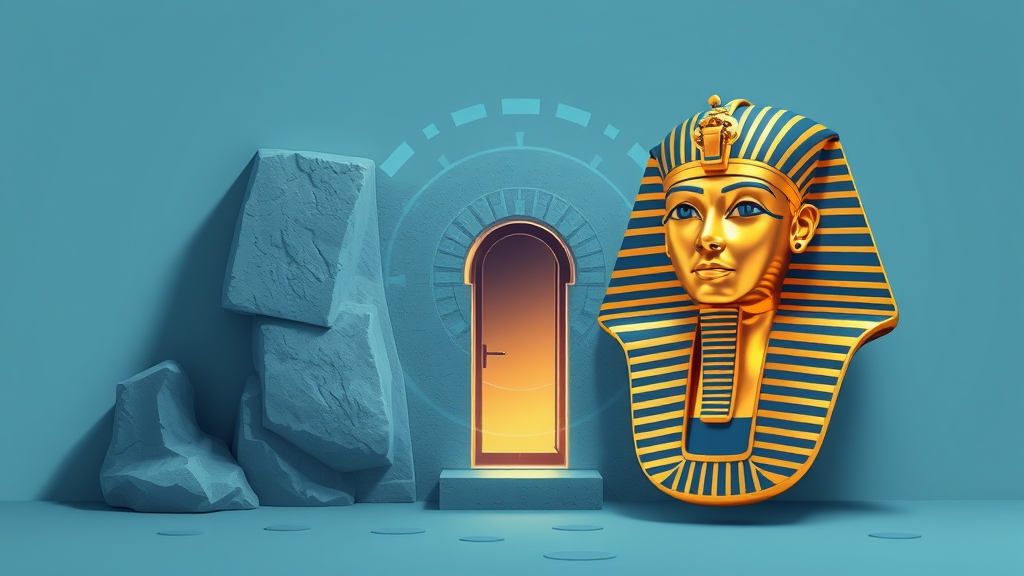

Some stories make me feel like a kid again and this is one of them. Researchers using ground-penetrating radar and microgravity surveys have identified what appear to be hidden chambers lying beyond Tutankhamun's tomb in Egypt's Valley of the Kings, according to Express.co.uk. Yes, hidden chambers. Behind the most famous tomb ever discovered.
Let me back up for a second, because the technology here deserves a moment of appreciation. Ground-penetrating radar works by sending electromagnetic pulses into the ground and listening for how they bounce back. Different materials, solid rock versus an empty void, return different signals. The microgravity survey is even cleverer: it measures tiny variations in the Earth's gravitational pull, and an empty chamber has slightly less mass than solid stone, so it shows up as a gravitational dip. Every time scanning technology like this gets better, we find something humanity walked over for centuries without even noticing.
I remember when the original Macintosh shipped with 128 kilobytes of memory and we all thought that was plenty. Now we're carrying more computing power in our pockets than entire research teams had a generation ago, and using it to peek through solid limestone into the past. My granddaughter Jess would tell me that's not technically how the processing works, and she'd probably be right, but the spirit of it stands. Our tools have quietly become magical.
The Tutankhamun story has captivated people ever since Howard Carter cracked open that sealed doorway in 1922 and Lord Carnarvon peered over his shoulder. Carter's answer to the famous question, "What do you see?" was "Wonderful things." For more than a century since, people have speculated that KV62, as the tomb is officially known, might not be the whole story. Plenty of them have dreamed, a little too hopefully perhaps, that a hidden passage might connect it to the tomb of Queen Nefertiti, whose final resting place has never been found.
That last theory has burned researchers before. In 2015, a researcher claimed radar had found evidence of hidden rooms in the tomb. Follow-up scans were inconclusive, tempers flared, and the "Nefertiti chamber" remained stubbornly hypothetical. This new survey work, combining two independent methods that both point to voids beyond the tomb, sits on firmer ground than anything we've had before. When two different instruments tell you the same thing, you pay attention.
Now for the patient part, which is where I gently remind everyone (my family hears this a lot) that excitement and confirmation are two different things. Radar can tell you a void exists. It cannot tell you whether that void contains a sealed burial, a storage room full of embalming materials, or absolutely nothing but empty air and disappointment. The only way to know for certain is careful physical investigation, and Egyptian authorities are rightly cautious about drilling or tunneling anywhere near a fragile, irreplaceable site. That process could take years.
And that's the part I love most about this story. Technology should work for you, solving real problems instead of creating them, and this is technology doing exactly that: answering a century-old question without breaking a single ancient stone. If those chambers really do hold wonderful things, Carter's ghost is somewhere smiling.
I'll be following this one closely and will report back when the archaeologists announce their next steps. In the meantime, don't let anyone sell you a "secret tomb revealed" documentary special just yet. We've been down that hallway before, and so far, it's been a wall.
Comments (0)
Log in or sign up to join the conversation.
No comments yet. Be the first.