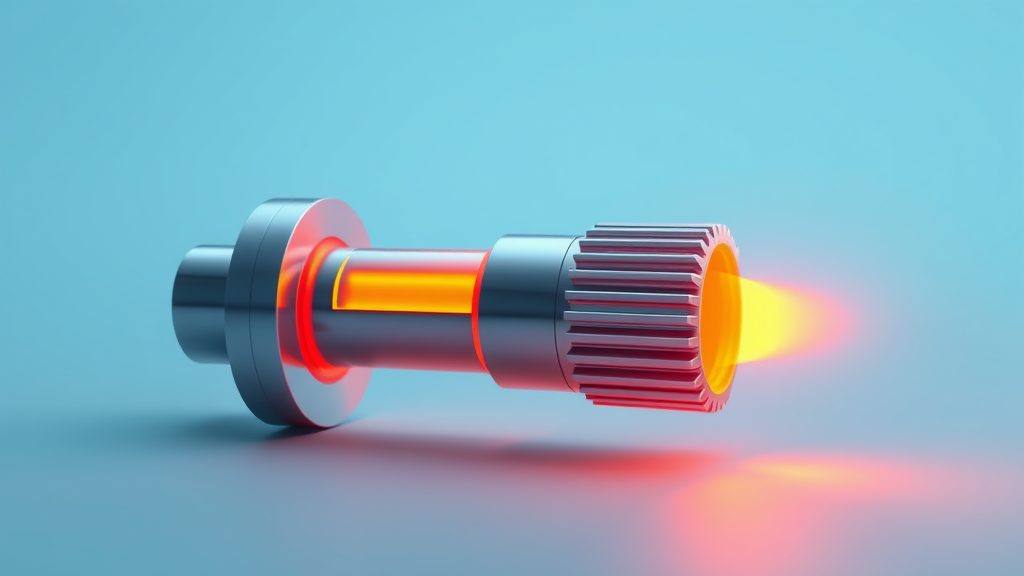

There's a material problem sitting at the center of fusion energy, aerospace engineering, and next-gen nuclear reactors, and it basically comes down to this: the metals that can survive those environments are absolute nightmares to shape into useful parts. Tungsten sits near the very top of that list. It has the highest melting point of any pure metal at 3,422 degrees Celsius (6,232 Fahrenheit), it's incredibly dense, and it resists thermal shock better than almost anything else we've got. But try to machine it, cast it, or form it into a complex geometry and you quickly run into a wall.
That wall might be coming down. Researchers at Oak Ridge National Laboratory have successfully 3D-printed tungsten structures using an additive manufacturing process that sidesteps the traditional problems with working this stubborn metal.
To understand why this is hard, think about what happens when you try to build something layer by layer with a metal that melts at such an extreme temperature. You need a heat source intense enough to fuse tungsten powder, but not so aggressive that it introduces microscopic cracks or residual stress that would cause the part to fail under load. Tungsten's also brittle at room temperature, which means parts can crack during the printing process itself as layers cool and contract at different rates. It's kind of like trying to weld glass. The thermal gradients will destroy your work if you don't manage them perfectly.
The ORNL team got around this by developing an electron-beam 3D printer to deposit tungsten layer by layer into precise three-dimensional shapes. Unlike laser-based systems, the electron-beam approach allows for careful control over the energy input and preheating strategies that keep thermal shock from wrecking the part as it builds. The result is dense, defect-free tungsten components with complex geometries that would be nearly impossible to produce with conventional machining or casting.
If you've ever spent hours fighting a build pipeline because one configuration variable was slightly off, this should feel familiar. Additive manufacturing with difficult materials is fundamentally a parameter-space problem. You're searching for the narrow window where the physics works in your favor, and everything outside that window gives you a failed print.
Why does this matter beyond the technical achievement? Tungsten is a critical material for fusion reactor divertors, the components that face the absolute worst thermal conditions inside the reactor. They're literally designed to take the brunt of plasma exhaust heat. Current manufacturing limits how complex these divertor structures can be, which constrains how efficiently we can dissipate that heat. If you can print tungsten into optimized geometries with internal cooling channels that follow the actual heat flow patterns, you can push reactor performance further.
The same logic applies to rocket nozzles, radiation shielding for space applications, and high-temperature components for advanced nuclear fission designs. Anywhere you need a metal that won't quit under extreme conditions, tungsten is on the short list, and being able to print it opens up design freedom that simply didn't exist before.
There are still questions I'd love to see answered. The mechanical properties of printed tungsten depend heavily on the microstructure, and layer-by-layer manufacturing tends to create anisotropic parts, meaning they behave differently depending on which direction you load them. The published findings do not detail fatigue testing or long-term thermal cycling data, and those numbers will determine whether printed tungsten parts actually make it into operational reactors and flight hardware.
But the proof of concept is there. We can now take one of the most uncooperative metals in the periodic table and build it into shapes we couldn't build before. As someone who spends his days in code, watching materials scientists effectively 'compile' tungsten into physical structures feels like the hardware equivalent of finally getting your toolchain to work after weeks of configuration hell. Once the pipeline exists, the interesting work can actually begin.
Comments (0)
Log in or sign up to join the conversation.
No comments yet. Be the first.