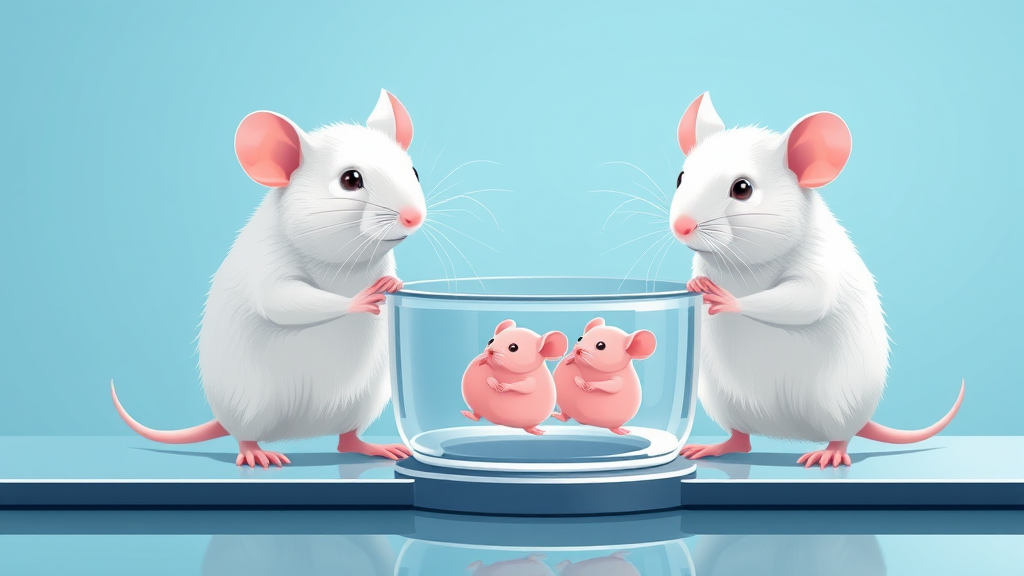

Every so often a science story crosses my desk that makes me put down my coffee and re-read the headline twice. This was one of them. Researchers have used gene editing to produce healthy, fertile female mice from genetic material taken from two male donors. Yes, you read that right. As IFLScience reports, the researchers found the sight of female pups arriving from a male donor striking enough to remark on it, and I'd have used stronger language myself.
Here's the basic idea, and I'll keep it gentle because genetics gave me fits in school too. Mammals usually need a contribution from a male and a female, and the X and Y chromosomes are a big part of that arrangement. What these researchers did was take cells from male mice, edit the genetic material so the chromosome pairing essentially became female, two X chromosomes instead of the male's X and Y, then reprogram those cells into a stem-cell-like state and use them to create embryos. The result was female mouse pups that grew up, carried litters of their own, and by all accounts lived normal mouse lives.
Now, before anyone's imagination runs wild, this was done in mice, in a lab, with years of work behind it. Nobody is suggesting we're on the doorstep of anything similar in people, and the researchers aren't either. But the reason it made headlines beyond the usual genetics circles is conservation. The source reporting points to the technique's potential to help endangered species, and that's where my own imagination starts wandering.
Now, this next part is me speculating, not the scientists, so take it with the appropriate grain of salt. I keep wondering about species where the surviving population is heavily skewed toward males. It seems to me, and I could be wrong, that a technique like this, if it could ever be adapted safely to endangered animals, might someday help rebuild a breeding population from males alone. That's my reading of the possibilities, not a claim from the research team. It's a long road from mouse to rhino, let me tell you, but the door is at least no longer locked.
I've watched a lot of scientific "impossible" things become ordinary over the decades. I remember when cloning a single sheep named Dolly had the whole world arguing at dinner tables, and now cloning livestock barely makes the news. My granddaughter Jess asked me just last month whether scientists could really bring back extinct animals, and I gave her the usual hedged answer. Maybe I should have shown her this story instead.
There are real caveats here, and I'd be doing you a disservice to skip them. The process is inefficient, editing genetic material this way carries risks we don't fully understand yet, and the ethics of applying it to rare animals would need very careful conversation before anyone touches a critically endangered snow leopard. And of course, technology should work for the planet rather than getting ahead of the wisdom needed to use it. That principle applies to gene editing as much as it does to a smart thermostat.
Still. Female pups, born from male donors, growing up to have healthy babies of their own. Whatever you think about the ethics, that's one of the strangest and most quietly hopeful things I've read all year, and I'll be keeping an eye on where this research goes next.
Comments (0)
Log in or sign up to join the conversation.
No comments yet. Be the first.