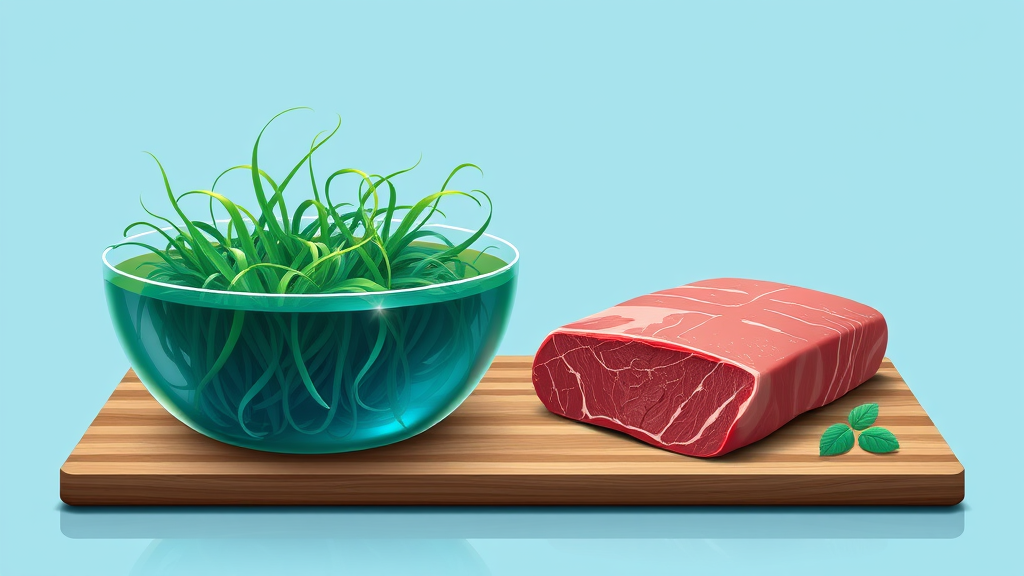

Every family has that one question that comes up at every holiday dinner. In mine, it's my granddaughter Jess asking whether I'm still getting enough B12, because I've been mostly vegetarian since about 2019. I usually wave her off with a handful of fortified cereal. But a new study might actually change how I answer her, and it involves one of the oldest organisms on Earth.
Researchers have produced a form of spirulina that contains biologically active vitamin B12 at levels comparable to beef. You can read the full findings over at ScienceDaily, and I'd encourage you to, because this is one of those quiet science stories that could end up mattering a great deal.
First, a little background, because spirulina deserves it. It's a blue-green algae that's been eaten for centuries, and if you walked into any health food store in the 1970s you saw it in every bin, promising everything from energy to enlightenment. My sister-in-law used to stir it into orange juice and swear by it. But the catch, the part supplement labels don't always make clear, is that the B12 in ordinary spirulina is what scientists call a pseudo-vitamin. It looks like B12 to a lab test, but your body can't actually use it. Worse, it can occupy the same absorption pathways as real B12 and potentially get in the way.
So what these researchers did is genuinely clever. Rather than trying to synthesize B12 in a factory the way most supplements are made, they cultivated spirulina under conditions that encouraged the algae to take up and retain true, biologically active B12. The result is a whole-food source of the vitamin with levels on par with beef, which has long been one of the richest dietary sources around.
Why does this matter so much? B12 deficiency is sneaky. It creeps up over months and years, and the symptoms, fatigue, tingling hands, foggy thinking, are easy to blame on being busy or getting older. Trust me, I know. The people most at risk are older adults, vegans, vegetarians, and anyone taking long-term acid reducers for heartburn. Up to now, the answer has been injections or synthetic pills, which work fine but which a lot of people forget, can't afford, or simply don't enjoy. A food that naturally carries usable B12 would remove that friction entirely. I've said it before about technology and it applies to nutrition too: the best solution is the one that works with your life instead of adding steps to it.
What makes this interesting beyond the nutrition itself is the sustainability side. Beef production is land-heavy, water-heavy, and carbon-heavy. Spirulina, by contrast, grows fast in ponds and tanks, needs a fraction of the resources, and can be cultivated almost anywhere, including places where cattle farming simply isn't practical. If a spoonful of algae can do the nutritional work of a steak, we might be looking at a real change in how we feed a growing population. I remember when plant-based burgers were the big promise, and some of them turned out to be highly processed salt bombs in nicer packaging. This feels different, because it's a whole food, not a chemistry project dressed up as one.
Now for my usual dose of patience, which I hope you expect from me by now. This is a research result, not a product on a shelf. Before anyone runs out and buys the first spirulina powder that mentions B12 on the label, remember that ordinary spirulina still contains mostly the useless pseudo-form. The enriched version will need scaling up, safety review, and honest labeling. If a jar at the health food store starts shouting about B12 next month without citing this specific cultivation method, be skeptical.
But I'll be watching this one closely. If it reaches the market at a fair price, it could be one of the most practical nutrition advances in years, especially for people like me who gave up beef but never quite gave up worrying about it. And the next time Jess asks about my B12, I might actually have a good answer for her. Maybe I'll even get her to try a smoothie...
Comments (0)
Log in or sign up to join the conversation.
No comments yet. Be the first.