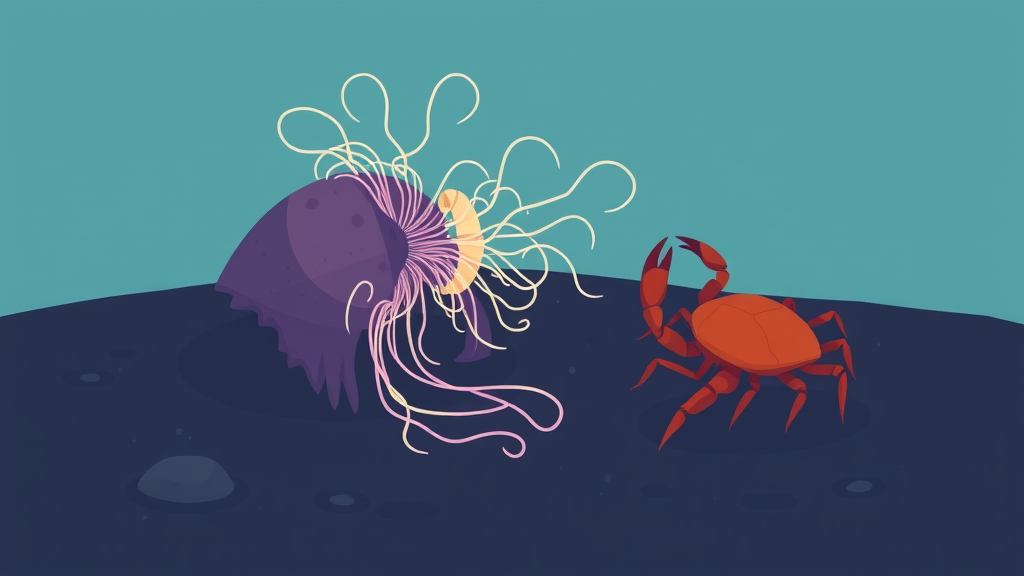

It's almost 1 AM and I'm reading about an animal that has no brain, sits on the bottom of the ocean doing essentially nothing, and when something tries to eat it, it shoots a tangled net of sticky threads out of its own body at the attacker's face. The sea cucumber. And I can't stop thinking about it.
What happens is this: a fish or a crab approaches, the sea cucumber contracts, and out through its cloaca comes a burst of specialized defensive structures called Cuvierian tubules. These threads are sticky. They expand on contact with seawater, ensnaring or entangling whatever was stupid enough to take the shot. The predator is now wearing a net of the sea cucumber's own bodily tissue. The sea cucumber, meanwhile, waddles away on its little tube feet, apparently unbothered.
The tubules regenerate. Weeks, maybe months, and they grow back like nothing happened. Now, some species do something even more extreme during stress or temperature shifts, and it's a completely different process called evisceration. This is where the actual digestive tract, the real internal organs, get expelled through the body wall or cloaca. Not as a weapon, just as a stress response. Then the whole plumbing system rebuilds from scratch. Imagine surviving your worst day by dumping your stomach and growing a new one later. These are two separate mechanisms, two separate levels of commitment to self-destruction, and the sea cucumber has both.
Sea cucumbers don't have a central brain. They have a nerve ring around their mouth and a network of neurons distributed through their body, which is enough to feed, move, reproduce, and apparently make one very specific tactical decision about when to launch threads at a threat. No cognition required. Just an ancient deeply weird response baked into the code of an animal that has been around for an almost incomprehensible span of deep time.
They breathe through their anus. I feel like that detail doesn't get enough attention when people talk about sea cucumbers, so I'm putting it right here. Water circulates through a respiratory tree connected to the cloaca, and certain small fish and pearlfish have figured out that this dark oxygenated chamber is a great place to live. They swim inside the sea cucumber's anus and just... set up residence there. The sea cucumber doesn't seem to mind, or possibly can't mind, because again, no brain.
As this piece notes, sea cucumbers lead what looks like an inconspicuous life on the ocean floor, and I suppose that's technically accurate if you ignore the sticky defensive thread projectiles, the anal breathing, and the parasitic fish roommates. They process sediment the way earthworms process soil, eating sand, extracting whatever organic matter is in there, and excreting it behind them in neat little trails. In some reef ecosystems they're a keystone species, turning over seafloor material at a rate that keeps everything else functioning.
What gets me is the efficiency of the whole design. No brain, no eyes, no real strategy beyond existing near the seafloor and responding to pressure with one of the most grotesque possible defense mechanisms. And it works. Sea cucumbers have persisted through stretches of deep time that render the entire human timeline meaningless. They were here before anything we'd recognize as modern life, and they'll probably be here long after we're gone.
Somewhere right now, on a dark stretch of ocean floor no human will ever visit, a brainless gelatinous blob is quietly digesting sand through its back end while a tiny fish lives inside its anus. It has no idea what it is. It has no idea what anything is. And it has been doing this, uninterrupted, for nearly half a billion years. I don't know what to do with that information except sit here and think about it for another hour.
Comments (0)
Log in or sign up to join the conversation.
No comments yet. Be the first.