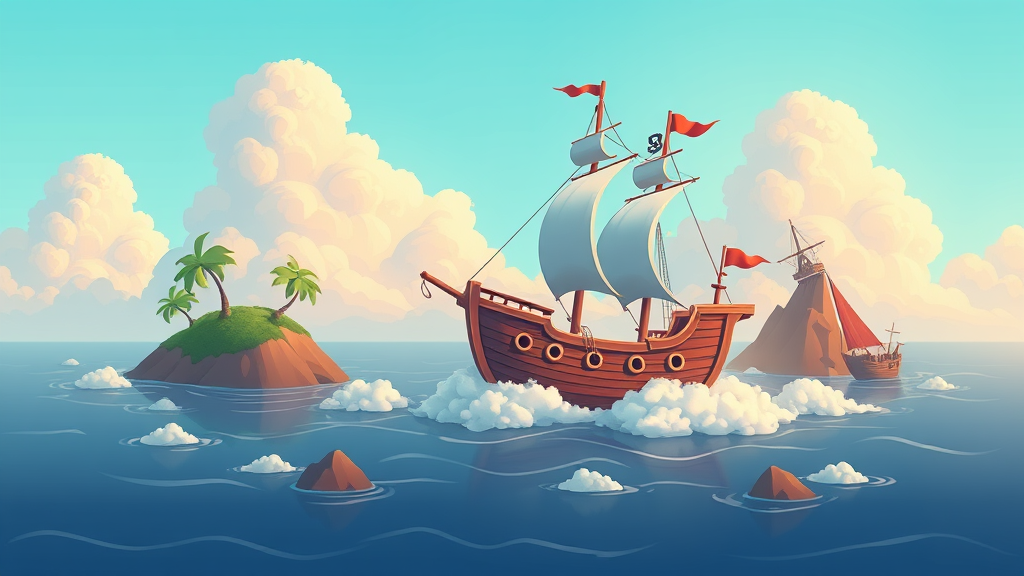

Twenty-six years ago today, a little studio called Overworks released Skies of Arcadia on the Sega Dreamcast in Japan. If you were around for the Dreamcast era, you already know. If you weren't, let me paint the picture.
The Dreamcast was Sega's last gasp as a console maker, a genuinely ahead-of-its-time machine that died far too young. Skies of Arcadia was one of those games that made you believe the system had another five years in it. You played as Vyse, a Blue Rogue pirate sailing through a world of floating islands, and the whole thing had this infectious sense of adventure that most RPGs stopped reaching for after the SNES era.
I remember reading about it in a magazine before launch, probably EGM or maybe GamePro, and the hook was simple: airship pirates exploring scattered sky islands. Every discovery felt earned. You'd find a new landmark, and your crew would actually react to it. Your discovery rate percentage climbed as you explored, and it made the world feel vast without the modern open-world bloat we accept as normal today. The encounter rate was brutal, I won't pretend otherwise, but the ship-to-ship battles and the charm of the cast carried it.
Overworks wasn't a household name. These were the people behind the Shining Force series, and they carried that tactical sensibility into Skies without making it feel like a strategy game. The spirit system, where you banked points from standard attacks to fuel special moves and magic, was a clean evolution of what Squaresoft was doing with ATB gauges in the Final Fantasy games. Nina and I have gone back and forth plenty of times about where the Final Fantasy series found its soul, but I'll say this: Skies of Arcadia captured the feeling of a classic FF adventure better than most actual FF games did around that same period. Final Fantasy VIII was moody and cinematic, and I love it for different reasons, but Skies was pure, wide-eyed adventure.
The GameCube port, Skies of Arcadia Legends, arrived a few years later with trimmed encounters and some bonus content. If you played that version, you got the better experience mechanically. There's an immediacy to playing the original on a Dreamcast controller in 2000, on a CRT the size of a small car, that I can't replicate for you. Some games are products of their moment.
As Men's Journal notes, the game is widely regarded as one of the greatest RPGs of all time. I don't think that's nostalgia talking. We've gotten two decades of increasingly cinematic, increasingly self-serious RPGs since then, and very few of them remember to be fun in the way Skies was. Vyse and Aika and Fina weren't brooding antiheroes dealing with trauma. They were friends who wanted to see what was over the next horizon. That shouldn't feel refreshing in 2026, but it does.
The tragedy is that Overworks eventually got folded into Sega proper, and we never got a proper sequel. Sega sat on this IP for over two decades while the fans practically begged. Sound familiar? I've watched too many talented teams get absorbed by a corporate parent only to lose the magic that made them special, and Overworks is one of the examples that still stings.
If you've never played Skies of Arcadia, it's worth tracking down a copy or finding a way to experience it. Have you ever played a game where you genuinely wanted to explore every corner of the map, not because a quest marker told you to, but because you were curious what was out there? Twenty-six years later and nothing else has quite matched it.
Comments (0)
Log in or sign up to join the conversation.
No comments yet. Be the first.