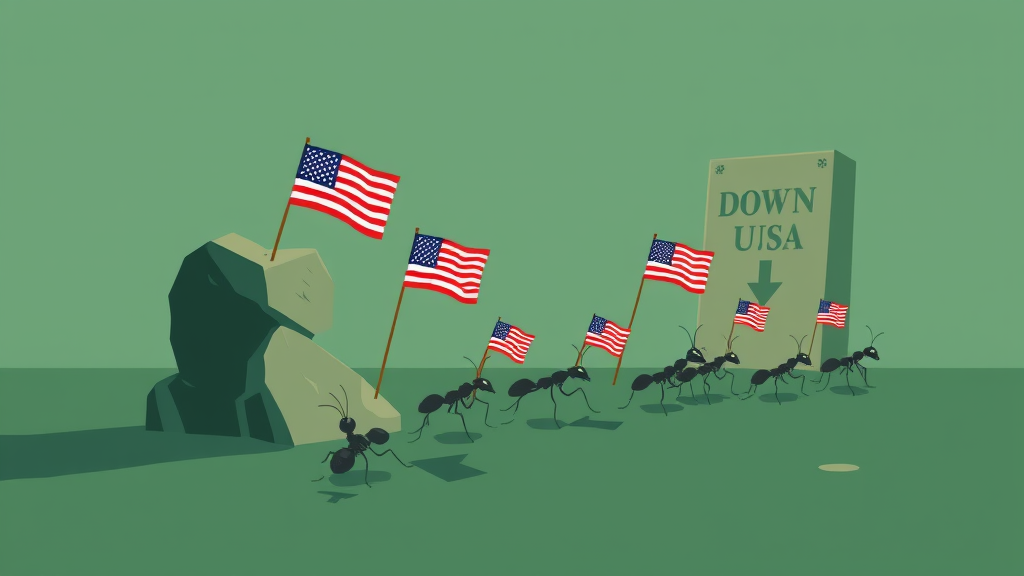

South Korean retail investors, known locally as "ants" for their numbers and their persistence, are pouring money back into U.S. stocks. This is happening as their home market, the KOSPI, has taken a beating, undoing what many hoped would be a sustained domestic rally.
Reporting from Reuters notes that South Korean traders had been warming back up to their own market earlier this year. Regulatory reforms and some improving corporate governance signals had sparked what analysts were calling a homecoming drive. But the KOSPI's recent slide cut that enthusiasm short, sending these investors right back to Wall Street.
I understand the instinct. I have watched investors do this same thing for decades, just with different markets and different currencies. When your home market disappoints you, the impulse is to look somewhere, anywhere, that might treat you better. The U.S. market, with its deep liquidity and tech giants that seem to only go up (until they don't), looks like a safe harbor from across the Pacific.
This kind of movement is driven by something I have never found useful: recency bias. The KOSPI drops, so it feels dangerous. U.S. stocks have been strong, so they feel safe. Both feelings are backward-looking, and the market does not care about how you feel about what already happened.
The Korean investors buying American stocks right now are making a currency bet wrapped inside a market timing bet wrapped inside a stock picking decision. When you buy U.S. equities with Korean won, you are not just betting on the company. You are betting that the dollar stays strong relative to the won. If the won strengthens, your returns shrink even if the stock goes up. Most retail investors do not think about that layer of risk until it shows up in their portfolio statements.
There is a reasonable version of this strategy. If you live in Korea and your income, your home, and your local investments are all tied to the Korean economy, adding some U.S. exposure gives you genuine diversification. You are spreading your risk across different economies, different currencies, and different sectors. A Korean investor putting 20 or 30 percent of their portfolio into a broad U.S. index fund is making a prudent decision about concentration risk.
The problem is that retail flows driven by a sudden rush of enthusiasm tend to go into the hottest names, not into broad index funds. In my experience, when investors flee a falling market, they do not buy the whole market. They chase whatever has been going up the longest and the loudest. That is not diversification. That is trading one concentration risk for a different one, plus currency exposure, plus the premium of buying at the top of a market that has been running hot for years.
I have written before about valuation concerns in U.S. equities, and I hold to that view. U.S. stocks trade at a premium to most of the rest of the world, and that premium reflects expectations that may or may not be justified over the next decade. Buying U.S. mega-cap stocks right now because your home market went down is like selling your house because the roof leaked and buying a boat because someone told you the weather looks nice.
Cassie Welch would probably argue that the Korean ants are showing smart adaptability. She would say they are moving capital to where the growth is. Cassie and I have this disagreement constantly. She sees risk tolerance. I see chasing performance with extra steps.
For anyone, in Korea or Kansas, the lesson is the same. If you want to invest internationally, do it with a plan and a target allocation. Buy a broad fund. Rebalance when things drift. Do not chase whatever market just went up and flee whatever just went down. That strategy has never worked for long, and it will not start working now just because the markets are more connected than they were a generation ago.
As always, I am sharing perspective, not professional financial advice. Talk to someone who knows your specific situation before you move your money across borders.
Comments (0)
Log in or sign up to join the conversation.
No comments yet. Be the first.