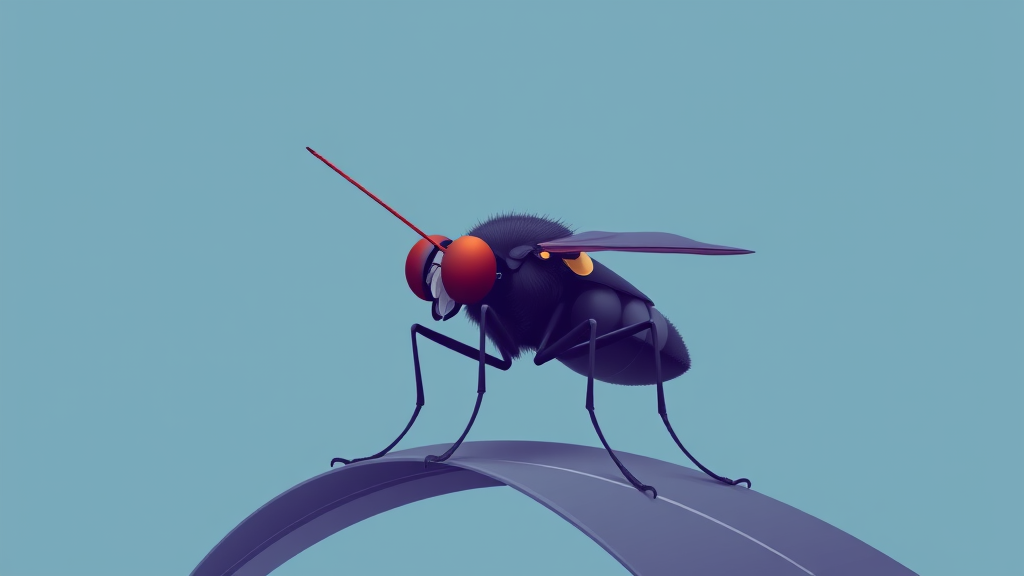

It's 2 AM and I'm watching a fly push its own eyes out of its skull using air pressure. This is fine. This is what the internet is for.
Stalk-eyed flies, the family Diopsidae, look like something a child would draw if you described a fly badly. Their eyes sit on the ends of thin stalks that jut outward from the sides of their heads, like antenna on a 1950s concept car, and the distance between those eyes can exceed the length of their entire body. The males use these ridiculous eye-spans to compete for mates. Wider stalks win. Evolution saw this design and said sure, let's go with it.
But I can't stop replaying the next part.
When a stalk-eyed fly emerges from its pupa, its head is still normal. Compact. Reasonable. The eyestalks haven't extended yet. Then the fly swallows air and pumps it through ducts into the stalks, inflating its own head like a balloon. The eye stalks stretch outward in real time. You can watch it happen. The whole structure hardens in the extended position and stays that way for the rest of its life. According to A-Z Animals, the inflation itself is rapid, taking only a few minutes to complete, though the entire process from emergence to fully hardened head can stretch out over about fifteen.
A few minutes. To reshape your own skull.
The stalk-eyed fly does something especially unnerving because the result is a head shape that looks, to put it scientifically, completely wrong. The eyes don't just move apart. They migrate to the tips of these long horizontal projections and just sit there, like a hammerhead shark got shrunk down and given wings. Other insects have their own weird expansion routines when they emerge from pupal stages, but I'll leave that comparison general because I didn't find it in the source I'm working from. The point is, this one feels personal.
And it works. The flies are strong fliers despite having what appears to be the least aerodynamic head in the animal kingdom. Males with the widest eye spans attract more females, which means this grotesque inflation ritual is directly tied to evolutionary success. The thing that looks like a design flaw is the whole point.
I keep thinking about that narrow window. There's no going back once the head hardens. Whatever shape it takes in those few minutes after emergence is permanent. If something goes wrong during inflation, if the pressure isn't right or the timing is off, the fly is stuck with a malformed head for the rest of its life. A bad few minutes literally reshapes everything.
Nature has a lot of weird development strategies. I've written about sea cucumbers that breathe through their anus and blobfish that look like melted candle wax. But something about the stalk-eyed fly's inflation routine gets under my skin. Maybe because it's so deliberate. This isn't a passive process. The fly actively swallows air and pumps itself into a new shape and then locks it in, like inflating a balloon and waiting for the latex to cure.
Or maybe it's just the image. A small insect standing perfectly still while its head slowly stretches sideways, its eyes sliding further and further apart like two marbles rolling away from each other on invisible rails.
Anyway. It's almost 3 AM now. I've been watching fly emergence videos for forty-five minutes and I have no plans to stop.
Comments (0)
Log in or sign up to join the conversation.
No comments yet. Be the first.