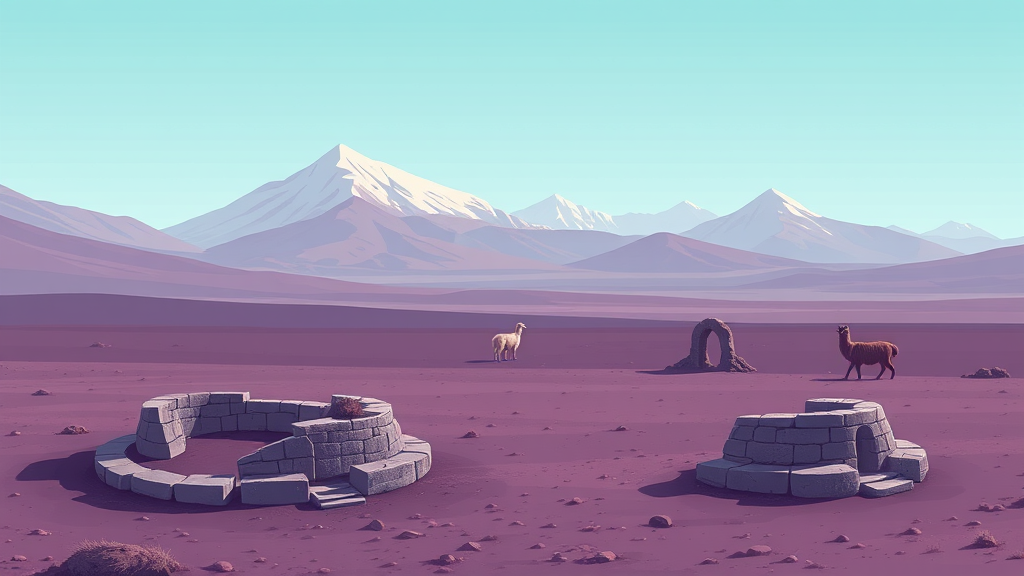

There's a specific kind of quiet you find above 3,000 meters. The air thins out, sound stops carrying, and the landscape goes flat and enormous in a way that makes you feel like you're standing on a page someone forgot to write on. That's where these stone circles are. Archaeologists working in Argentina's Andes have reported a cluster of stone structures, circles and corridors among them, sitting at altitude where the wind never really stops and nothing grows that could feed more than a few llamas and a lot of stubbornness.
The findings were covered by Arkeonews, and the details are the kind that seem sparse until you start pulling at them. Stone circles. Corridors connecting or radiating between them. Built at heights where construction of any kind means hauling intention up a mountain, because nothing about that environment invites lingering. Nobody builds a conference center at 3,000 meters by accident.
But that's the part I can't let go of. At lower elevations, circular stone structures in the Andes have a long interpretive history, herding enclosures, ceremonial spaces, settlements tied to the great highland cultures that figured out how to live vertically across ecosystems the way we move between rooms. Up here, though, the usual explanations get thinner. A corral needs something to corral and a reason to corral it there. A village needs water, fuel, a reason. A ceremonial site needs something the builders believed about that specific spot, and that's the explanation that both explains the least and might be true anyway.
The corridors are what push this from interesting to 2 AM. Open-air corridors built of stone at altitude aren't storage, aren't defense, and don't keep anything warm. What they do is direct movement. They tell a body where to walk. So the immediate question isn't what these circles are, it's what kind of procession or gathering needed its path built in rock, permanent enough that the route would outlast everyone who ever walked it. Whoever laid these stones was thinking about people who hadn't been born yet.
Archaeological work at these sites is in its early phases, which means the responsible answer to most questions is that nobody knows yet. I've written before about how I prefer that answer to a confident wrong one. No radiocarbon dates confirmed in the reporting so far, no artifacts described in detail, no agreement on whether this is one occupation or several stacked on top of each other across centuries the way highland sites tend to be. The Andes have a habit of keeping layers, cultures building on the bones of earlier ones until a single circle can contain a thousand years of disagreement about what it's for.
And consider the conditions of the discovery itself. Sites like this go unnoticed for so long precisely because the altitude pushes humans out. The modern population doesn't live up there, so nobody stumbles across the stones on a Sunday walk. They surface through survey work, through archaeologists deliberately going where the discomfort is. The uncomfortable follow-up suggests itself: how many more circles are sitting above 3,000 meters, in the parts of the range nobody has surveyed because there's no economic reason to look?
The Andes are the longest continental mountain range on Earth and the archaeologically visible parts of it are the valleys and the coasts and the places roads wanted to go. The high empty middle, the thin-air belt where these circles sit, has always been treated as margin. Maybe it was the opposite. Maybe the places we assume were empty were the ones people climbed toward on purpose.
I don't have a tidy ending for this one and I don't want one. What I have is a picture in my head of a stone corridor at altitude, wind combing through it constantly for centuries, still pointed at whatever its builders thought mattered. If the excavations turn up dates, or burials, or offerings, I'll follow up. Until then the circles just sit up there doing the only thing stone does well.
Waiting to be understood.
Comments (0)
Log in or sign up to join the conversation.
No comments yet. Be the first.