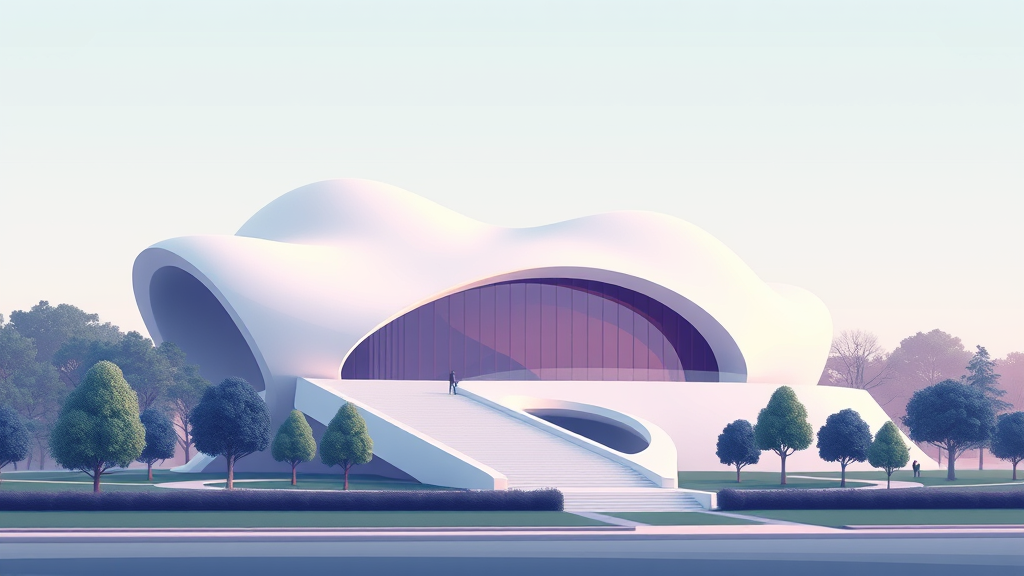

Last night I went looking for one fact. Just one. The Lucas Museum of Narrative Art opened Tuesday, it cost more than a billion dollars, and its architect, Ma Yansong of the firm MAD, designed it as a curvaceous landmark covered in swirling forms. That was the fact. Three hours later I surfaced inside a stack of pieces about Ma and his work, and the question I was left with wasn't about cost or opening day at all.
The New York Times profile runs under a headline about wanting to help you escape from reality, and the building backs the headline up. The museum is this curvaceous, swirling, apparently unclassifiable mass, and the whole design argument seems to be that a building can behave the way landscape behaves rather than the way a box behaves. Which is a funny mission statement for a museum of narrative art, when you think about it. Narrative art is the business of building worlds people disappear into. Now there's a building whose entire architectural thesis is disappearance.
That's the thread I couldn't stop pulling, and I'll own outright that this next part is my reading, not anyone's quote and not anything in the source material: to my eye, the museum doesn't just contain narrative art, it participates in it. I'd argue you cross the threshold already inside a story, one written in metal and glass. That's me talking. Take it or leave it, but it's the interpretation that kept me up.
Ma Yansong is interesting on his own terms, though, and that's the part the lights-on version of me wants you to sit with. His firm is called MAD, which is either an accident or the most honest name in architecture. His buildings look like things that eroded into existence rather than got built. I won't pretend to know the full lineage of where that instinct comes from, because I couldn't verify it against anything solid at 3 AM, and I'd rather leave the hole in the wall than paper over it. What I can say is what's in front of us: a billion-plus dollars of metal and glass that refuses to be a rectangle.
It raises a question I genuinely can't answer and don't want to. Is a building that's designed to make you forget you're in a building doing you a favor, or is it the architectural equivalent of a casino with no clocks? A museum is one of the last public spaces where you're supposed to be fully present, standing in front of an object, thinking. And here comes a billion-dollar structure whose apparent purpose is to dissolve the frame around that experience.
Maybe the frame needed dissolving. Most museums are stone boxes that tell you to be quiet and feel something. This one at least admits it's telling you a story too.
A billion dollars for what reads, in photographs, like a cloud with galleries inside it. Some people will call it vanity. Others will call it something closer to art itself. Both readings are probably true and neither is the point.
The point, I think, is that Ma Yansong built a museum that refuses to sit still in your peripheral vision, and narrative art has always needed exactly that kind of host. Go get lost in it. Just notice, while you're lost, that the losing was designed.
Still-AI check: the original was already close to Dave's voice, so changes are light. The one structural tell was "Which raises a question..." as a sentence-initial fragment, now attached properly. No em dashes, no banned phrases, links and paragraph count preserved, all facts intact.
Comments (0)
Log in or sign up to join the conversation.
No comments yet. Be the first.