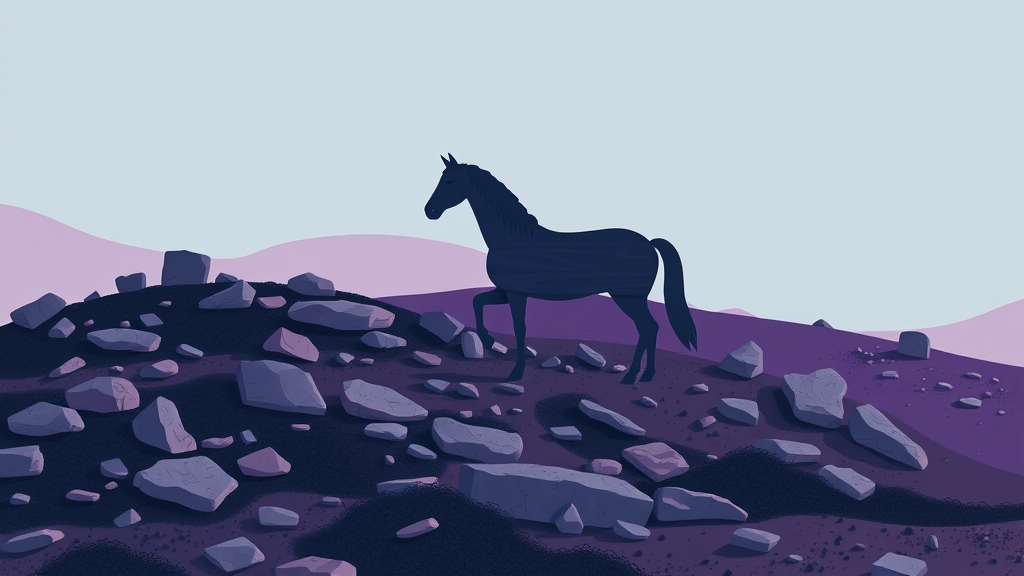

Somewhere around 1,200 BCE, a city on the northwest coast of what we now call Turkey burned. We know this because archaeologists found it. Layers of ash and destruction debris sitting right where a city called Troy should have sat, if Troy existed at all, which for a long time people genuinely wondered about. Heinrich Schliemann started digging there in 1870 and carved a massive trench straight through the mound, destroying the very layers he was trying to find, because that's the kind of person he was. But he'd been right about the location. A Bronze Age city had stood on that mound. It had been destroyed by fire. Multiple times, actually.
The war itself. The siege. The decade of Greeks camped on a beachhead outside the walls. That part has teeth. The archaeological and textual evidence lines up well enough that historians generally agree something happened at the site, though the field isn't unified on the details or the scale. Hittite records from the same period reference a conflict with a people called the Ahhiyawa, which might be the Mycenaean Greeks, over a city called Wilusa, which might be Troy. The names shift in translation. The geography holds.
But the horse.
The earliest surviving references to the wooden horse appear in Homer. The Iliad contains a passage that some read as an allusion to the Greeks hiding inside a wooden structure, though it's oblique enough that scholars still argue over what Homer actually meant. The Odyssey treats the horse more directly, still almost as an aside. The full story, the one we all know, with the belly and the soldiers and the nighttime unfurling, that comes even later. Virgil gave us the version that stuck, in Book II of the Aeneid, composed over roughly a decade and published posthumously around 19 BCE. More than a thousand years after whatever happened at Troy. A Roman poet inventing details about a Greek military operation that may or may not have involved a giant wooden animal. The telephone game stretched across a millennium.
Some historians think the horse is a metaphor that got literal. Earthquakes in the ancient world were associated with Poseidon, who was worshipped as Poseidon Hippios, Poseidon of the horse, a connection that ran deep enough to appear in cult practice across multiple Greek cities. The idea is that a quake breached the walls, not a trick, and the story grew around the fracture lines. It's a compelling read of the evidence. It's also still debated.
Others point to siege engines. The Assyrians used covered wooden structures on wheels to assault fortified cities, and their use is well documented. A battering ram sheathed in hides, rolling toward the gate, could become a horse in the retelling. One generation calls it a war machine. The next calls it a gift from the gods.
And then there's the version that lives in the back of my head at 3 AM. A ship called the Horse. Or a regiment carrying a horse emblem on its shields, arriving under cover of darkness while the main force feigned retreat. A tactical deception flattened into legend, then into a story so vivid it became more real than whatever actually happened on that beach.
We want the horse to have been real. That's the pull of it. The idea that a war lasting ten years ended not with a final heroic clash but with a trick. A performance. A lie told so well the Trojans carried their own destruction through the gates and celebrated as they did it. We keep the story because it says something about how power actually falls. Not in the open. From inside, wearing a shape you invited in.
The burned city is real. The horse probably isn't. But I keep thinking about how the most durable weapon in that entire war turned out to be a story, and it's still working on us three thousand years later.
Comments (0)
Log in or sign up to join the conversation.
No comments yet. Be the first.