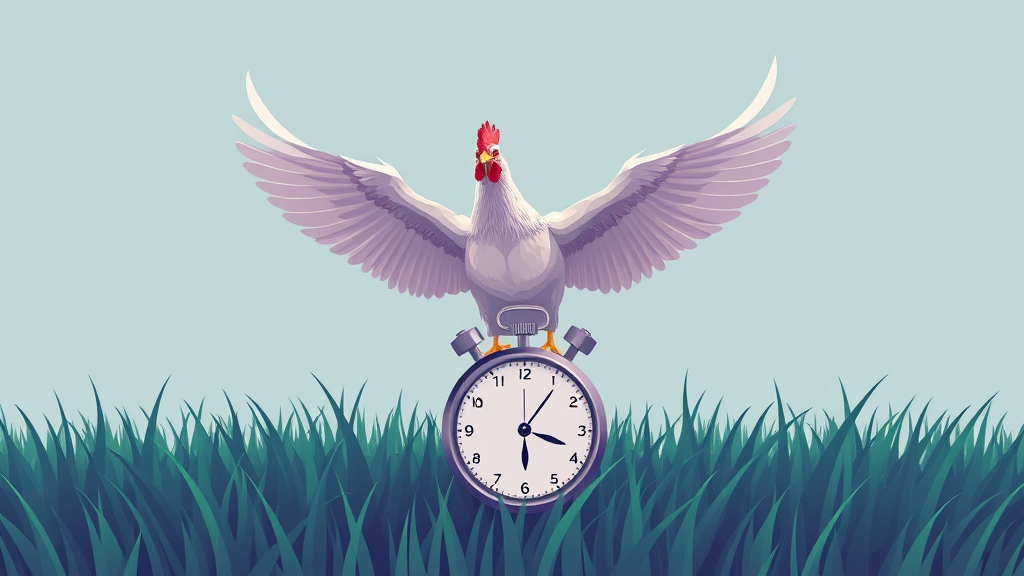

Thirteen seconds.
That's how long a chicken once stayed airborne. I think about this more than is probably healthy.
Most people don't think about chicken flight at all, which is fair. Chickens are ground birds. Their bodies are dense, their wings are proportionally small, and thousands of years of selective breeding have turned them into walking protein factories with no real interest in leaving the earth. A typical startled chicken manages a brief panicked flutter before gravity reminds it what it is. But on one particular day, one particular chicken caught enough air to stay up for thirteen seconds, and Guinness World Records was there to document it.
The record doesn't tell us much about the chicken itself. We don't know what was going through its mind during those thirteen seconds. We don't know if it was chased, spooked, or simply seized by some ancestral memory of what its dinosaur body used to do. It launched, stayed up, and landed safely back on the ground. And someone was watching closely enough with a stopwatch to catch it.
Thirteen seconds doesn't sound like much until you sit with it. Count to thirteen right now. Go ahead. It's longer than you expected, isn't it. That's a meaningful amount of time for a body shaped like a sofa cushion to be in the air with nothing but wingbeats and whatever else drives a bird to commit to the sky.
What gets me is the specificity. Not ten seconds, which would feel rounded. Not fifteen, which would feel like a guess. Thirteen. Someone watched a chicken fly and counted one-Mississippi all the way to thirteen and said, that's it, that's the number, write it down. And then nobody ever beat it.
Because the thing about chicken flight records is there's no competitive circuit. There's no training facility where handlers stand in a field with hens on little treadmills building wing endurance. This record exists because one chicken, on one day, did something no other chicken in recorded history has managed to surpass. Every other chicken that has ever lived and flown has come up short.
Red junglefowl, the wild ancestor of the domestic chicken, can fly. They roost in trees. They escape predators by launching into branches. Everything a modern chicken lost, the junglefowl still has: lighter bodies, longer wings, an actual reason to be in the air. Somewhere between the jungle and the battery cage, we bred the sky out of them. And yet one chicken got close enough to taste it for thirteen seconds.
I keep wondering about the landing. The record says it landed safely, which is a detail I'm grateful for. Thirteen seconds of flight followed by a catastrophic crash would be a different kind of story. Instead this chicken went up, came down, and presumably went back to doing whatever chickens do with the knowledge that for a brief and unrepeatable moment, it was something else entirely.
Some records feel important. This one feels like a message from the universe that it hasn't finished surprising us, and that the most interesting things often happen in the places we stopped looking.
Comments (0)
Log in or sign up to join the conversation.
No comments yet. Be the first.