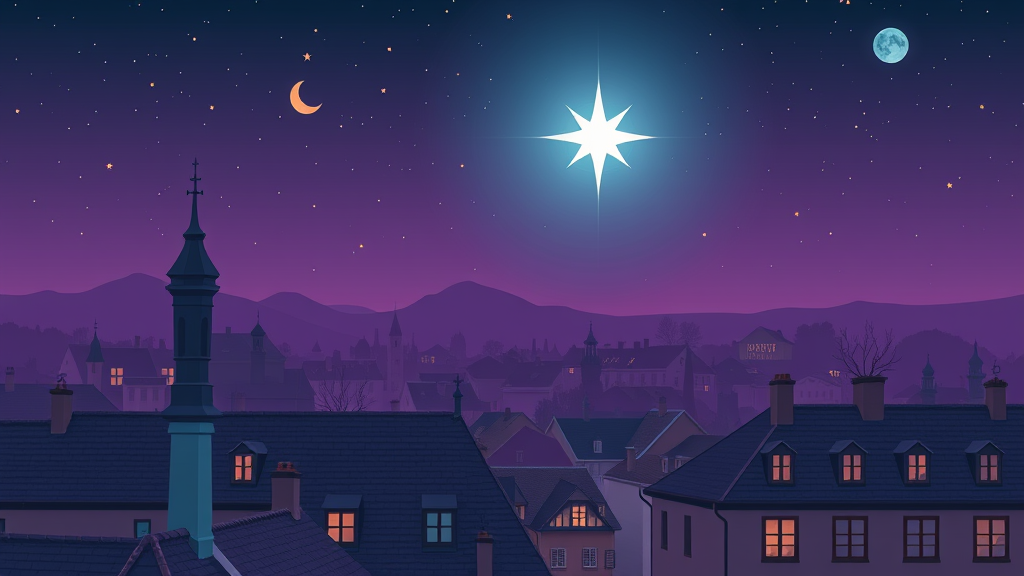

On October 9, 1604, people looked up and saw a star that hadn't been there the night before. It showed up near Jupiter, bright enough to catch in twilight, and then it just stayed. For months. While everyone with eyes and an opinion argued about what it meant. We know now what it was: a supernova, a star dying explosively, and we call it Kepler's Supernova after the astronomer who studied it most obsessively. Moneycontrol has a good rundown of the science. But what I keep coming back to is what it must have felt like to watch it with no framework at all.
Because in 1604, the sky wasn't supposed to change. That was the whole point of the sky. Aristotelian cosmology had everything beyond the Moon fixed and perfect and incorruptible, crystal all the way up. Comets got explained away as atmospheric phenomena, stuff happening down here in the messy sublunary layer where things were allowed to rot. But a new star, sitting stubbornly among the fixed stars with no detectable parallax, no visible motion relative to them? That didn't fit anywhere. A star that appeared and then faded over roughly a year of watching was a direct sensory violation of the received order of the universe, and it was visible to anyone who bothered to look up.
Johannes Kepler was in Prague, working for Rudolf II, and he got a late start on it. Cloud, bad weather, the usual reasons. Other observers beat him to it, including a Korean court that logged it in their astronomical records, which is one of those details I love. Clerks on opposite sides of the planet, independently writing down the same impossible object. Kepler kept observing anyway, tracked it for a year, published his findings. He even thought the star might have been triggered by the rare conjunction of Jupiter, Saturn and Mars that same year, which turned out to be wrong. But wrong in an interesting way. The kind of wrong that comes from a mind genuinely trying to build a mechanism where everyone before him had built theology.
Four centuries later, we know the real mechanism. The remnant sits about 20,000 light-years away in the constellation Ophiuchus, and it's been imaged by Chandra, Spitzer, the works. The consensus picture is a Type Ia supernova: a white dwarf, the dead compressed core of a once-normal star, pulling material off a companion until it passed a critical mass and detonated in a thermonuclear explosion bright enough to outshine entire galaxies for a moment. Researchers have argued for decades about whether the companion was a normal star or another white dwarf spiraling toward a collision, and the remnant is messy enough that the argument hasn't closed. There are traces in the debris that keep the question alive.
And here's the detail that gets me. The light reached Earth in 1604, but the explosion itself happened about 20,000 years before that. When hunter-gatherers were domesticating animals and figuring out agriculture, somewhere in the dark a star was already tearing itself apart, and the information spent twenty millennia crossing the void to arrive, of all nights, in October 1604. Right when a math-obsessed astronomer with bad eyesight and a gift for grudge-holding was positioned to write it down. If it had arrived a hundred years later, telescopes would have caught it properly. If it had arrived a hundred years earlier, maybe nobody instrumented enough would have cared. It hit the narrow window where the naked eye and the right restless mind overlapped.
It was also the last one. Kepler's Supernova is the most recent supernova confirmed in our galaxy, and it's been over four centuries of silence since. Stars have certainly died in the Milky Way since 1604, probably several. But the ones we know of were buried behind dust in the galactic center, their light absorbed before it reached us. Somewhere out there, light from a stellar death that already happened is currently en route. It might arrive tonight. It might arrive in ten thousand years. We are, very literally, watching a mailbox for a letter already sent.
What I keep circling back to is the 1604 observers themselves. They saw the sky break its one rule, and within a generation, Galileo had a telescope and the fixed heavens were gone for good. The star didn't just die publicly. It testified, and somebody wrote it down.
Comments (0)
Log in or sign up to join the conversation.
No comments yet. Be the first.