
It started with algae.
That's the part I can't get past, sitting here at nearly midnight reading about this year's Nobel Prize in Physiology or Medicine. Three scientists shared the award for developing optogenetics, the technique that lets researchers turn specific nerve cells on and off with pulses of light, and the whole thing traces back to single-celled pond organisms that evolved a way to sense sunlight millions of years before anything had a brain to wonder about it. The Smithsonian has the full story, and it's worth your ten minutes.
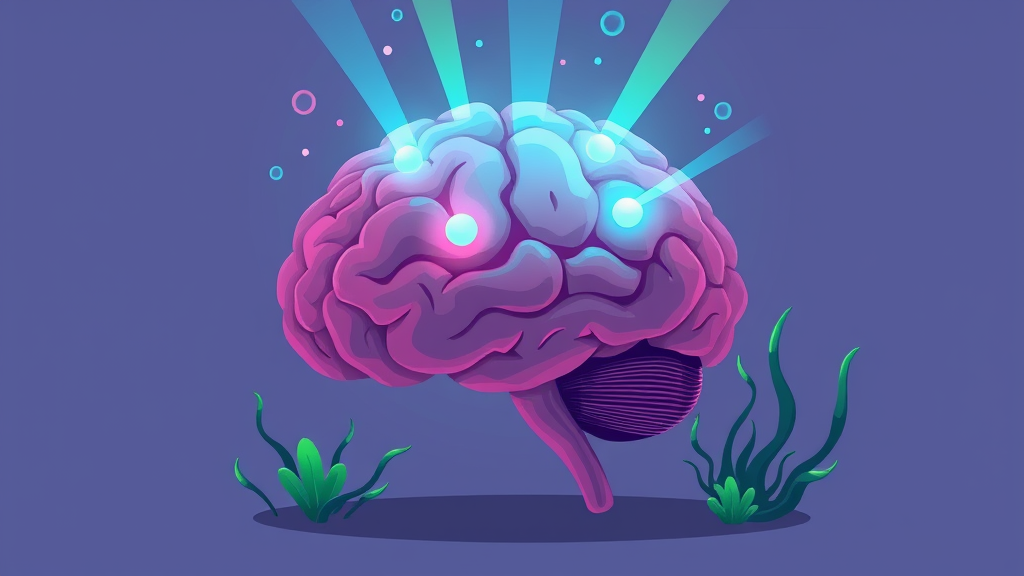
So, the mechanics, stripped down. Certain algae and microbes produce proteins called opsins, which respond to light by shifting shape and opening channels in a cell membrane. The prize-winning insight was that you could take the gene for one of these opsins, insert it into a specific population of neurons, and suddenly those neurons, and only those neurons, fire when you shine light on them. Blue light clicks them on. A different opsin clicks them off. A flashlight for the brain, except the flashlight was invented by pond scum and the scientists just figured out where to point it.
Before this, neuroscience had a crudeness problem. If you wanted to know what a circuit of neurons did, you could lesion it, which is like figuring out what a fuse does by burning down the house. Or you could record from it while the animal did something and try to infer causality from correlation, which is its own kind of guessing game dressed up in statistics. Optogenetics let researchers do something that had genuinely never been possible in the history of the field: activate one cell type, in a behaving animal, at a moment of their choosing, and watch what happens. Cause, then effect, in milliseconds.
The technique has since spread through neuroscience the way a good ghost story spreads through a small town. Labs use it to trigger thirst, hunger, aggression, parental instinct, the urge to freeze in fear. Researchers have used it to restore some vision in blind animals by making retinal cells light-sensitive again, and clinical trials in people with degenerative eye disease are underway. Work is being done on Parkinson's, epilepsy, depression, paralysis. The Nobel committee's language about "unraveling the brain's mysteries" sounds like boilerplate until you remember that the brain is the single least understood organ we own, and that this is one of the few tools that ever gave us real traction on it.
What I keep circling back to is the deeper strangeness, though. The claim embedded in this method is that the mind has a dimmer switch. Flip a light at the right wavelength in the right cells and a mouse becomes aggressive, or calm, or hungry for a food it just ate to fullness. We are, apparently, machines with a lighting system, and this prize is the world's most prestigious institution admitting that we found the switch. Whether the switch is the same thing as the self, whether flipping it in a mouse tells you anything true about the thing staring back from a mirror at 2 AM, those questions stay wide open.
The prize went to three researchers because that's how these discoveries actually happen, in pieces, across decades, one lab building on another's dead ends. Nobody sat down and invented optogenetics over a weekend. I find that oddly comforting. The biggest answers in science tend to arrive sideways, borrowed from organisms that never got the credit and never needed it.
Anyway. A microbe invented a light switch, we stole it, and now we're inside the skull flipping it in the dark to see what growls. If that doesn't deserve a medal, I don't know what does.
Comments (0)
Log in or sign up to join the conversation.
No comments yet. Be the first.