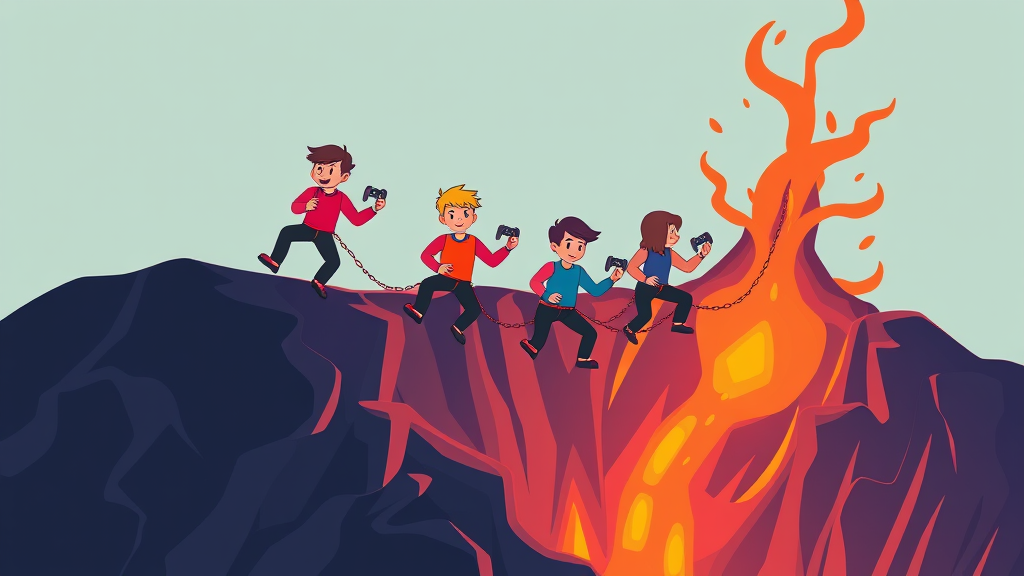

There's a word making the rounds lately that I kind of love: friendslop. If you haven't heard it yet, you will. It's the label people are slapping on cheap, janky, relentlessly social co-op games, the kind you buy for ten bucks on a Friday night because three of your friends already did. RTÉ has a good piece on the phenomenon, and it uses Chained Together as its poster child, which is exactly right.
If you haven't played Chained Together, the pitch is simple: you and up to three friends are literally chained to each other, climbing out of hell. One person slips, everybody falls. It will almost certainly end in an argument. That's the point. It's as silly as it sounds, and it costs about as much as a sandwich.
This genre, if you can call it one, has been building for a while. Fall Guys kicked the door open, Among Us turned it into a pandemic-era obsession, and then came the wave: Content Warning, Lethal Company, R.E.P.O., and a hundred others. Big Walk, which I reviewed last month and loved, sits on the fancier end of the same spectrum. The connective tissue isn't graphics or mechanics. It's the shared experience of watching a friend ruin everything.
And there's a lesson here the big publishers keep fumbling. These games are cheap, usually $10 to $20, often ugly on purpose, and they sell like crazy because the barrier to entry is basically nothing. Nobody has to lobby three friends into a $70 purchase. Nobody needs to clear their whole weekend. You buy it, you play it for ninety minutes, and whether it holds together or collapses into laughter is almost beside the point.
I've been around long enough to remember when this was just how multiplayer worked. Before matchmaking and ranked ladders, we had four controllers and a couch. Mario Kart 64 and GoldenEye weren't "friendslop," they were full-price games, but the social engine underneath was identical: cheap laughs, betrayal, someone throwing a shell at the wrong moment. Ever blown a first-place finish in Bowser's Castle because your buddy was saving that shell for the final stretch? Then you already understand Chained Together. Decades of online infrastructure made multiplayer more efficient and somehow less fun per dollar. The friendslop wave is players clawing some of that back.
The economics matter too. Nina and I were talking about this after the Dawnwalker numbers came out, because it's the same underlying signal. Players are voting with their wallets for focused, reasonably priced experiences over the $80 live-service treadmill. Friendslop is the budget end of that same rebellion. A $12 game that makes you laugh for two nights beats a $70 game that respects your time for exactly one weekend before the battle pass starts nagging.
Now, some caveats. A lot of this stuff is disposable by design. Chained Together isn't going to change anyone's life, and for every hit like Lethal Company there are fifty dead-on-arrival clones rotting in Steam's new releases queue. The genre works precisely because nobody involved, developer or player, is pretending it's high art. The moment someone tries to make a $40 "premium" version of this formula with a season pass, the whole thing curdles.
But as a direction for the medium? I'll take it. Games got expensive, bloated, and self-serious, and in response players found a corner of the market where the only thing that matters is whether your friends will still speak to you afterward. Oldest trick in the book. It's just wearing a cheaper cover price now.
If your crew needs something for the weekend, grab a chain. Just decide in advance whose fault the fall is. It'll save time.
Comments (0)
Log in or sign up to join the conversation.
No comments yet. Be the first.