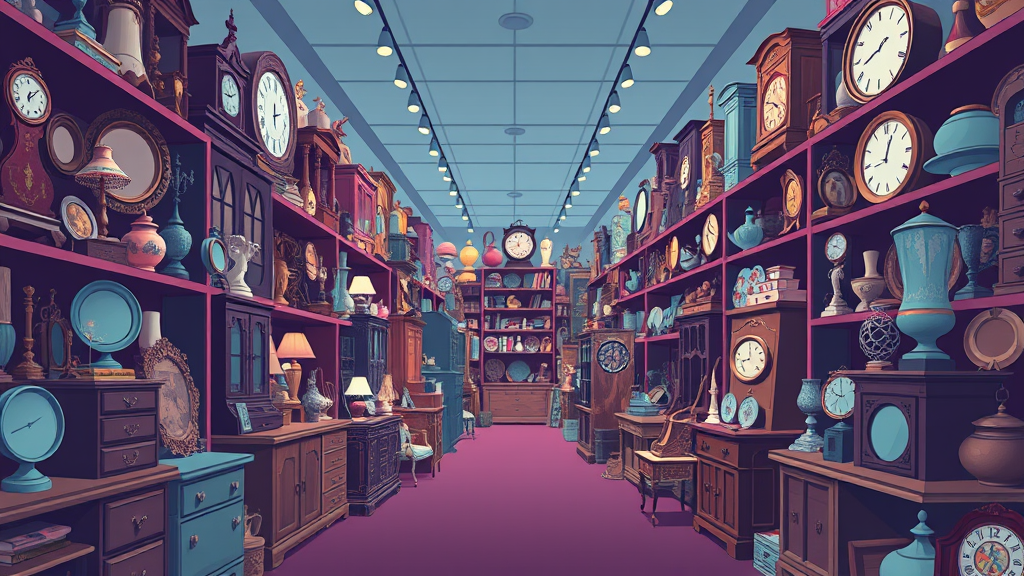

I've written before about antique shops as unsolved cases, the one in Washington where every shelf is a mystery waiting for someone who'll never come back to explain it. Ohio, it turns out, is sitting on a whole network of these places, and someone at Everafter in the Woods put together a list of thirteen enormous secondhand shops, each one packed with furniture, vintage decor, and antiques, each one pitched as worth the drive. You can read the full roundup here.
What gets me about shops like these isn't the treasure framing, the idea that you might find a mid-century dresser for forty bucks. Fine, sure, that happens. What gets me is the density. A shop big enough that you lose your bearings in it must hold, and I'm estimating here, tens of thousands of objects, and every single one of them was chosen by a person, owned by a person, and then let go of. Died, moved, divorced, downsized, or just got tired of looking at it. The objects survive the decision. The decision doesn't survive anything.
And that's what I keep circling back to with secondhand shops. A roadside attraction is a mystery with a gift shop. An antique mall is a mystery with price tags. You walk the aisles and you're reading the sediment layers of a few hundred households, all jumbled together, and occasionally two objects from different lives end up adjacent in a way that accidentally tells a story nobody intended. A christening gown hanging next to a set of shot glasses. A portrait of somebody's uncle watching you from between a lamp and a typewriter. The uncle always gets me.
The list is framed as a treasure-hunting road trip, and that framing is doing a lot of work. I can't tell you the exact mix of formats on it, whether we're talking multi-dealer malls where a hundred vendors each curate their own little territory or country barns where the inventory seems to have accumulated rather than been arranged, because I haven't walked all thirteen and the roundup doesn't spell that out. But Ohio does this category unusually well in general, partly because the state is old enough and dense enough to have generations of stuff cycling through, and partly because the farmhouse-and-barn real estate out there can hold volume that a city shop can only dream about.
The hunting is the point, at least in my experience of shops like these. If you go in looking for one specific thing you'll leave angry. If you go in looking for nothing you'll leave with a car full of it. You wander. You pick things up and turn them over. You find a box of photographs from 1974, someone's entire lake vacation, priced at two dollars, and you stand there doing the math on how a life ends up in a box at two dollars, and then you buy the box because somebody should.
I won't pretend I've visited all thirteen, and I won't invent details about shops I haven't walked through. What I'll say is that the format itself, the enormous packed-to-the-rafters secondhand barn, is one of the last physical places where serendipity still reliably happens. The algorithm can't recommend the weird brass thing at the bottom of a bin. Nobody has tagged it. Nobody knows what it is, including the dealer, which is why the tag just says "brass thing, $8."
That's rarer than it used to be, and it's worth burning a tank of gas across Ohio for. Every object in those buildings outlived its owner's interest, and now it's waiting, patiently, in the dark between the fluorescent lights, for the one person who will recognize it and take it home.
The uncle portrait, though. If you find him, buy him. He's already watching you.
Comments (0)
Log in or sign up to join the conversation.
No comments yet. Be the first.