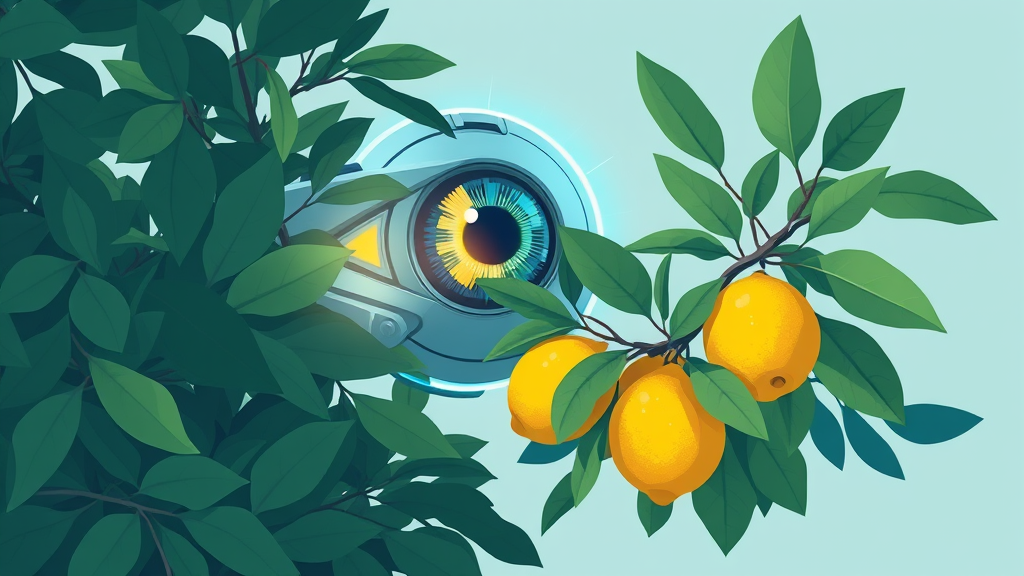

Computer vision has gotten really good at spotting things in images. Throw a lemon behind three layers of leaves and suddenly your state-of-the-art object detection model starts sweating. That gap between lab conditions and actual orchard conditions is exactly what researchers at the University of Canterbury are closing with a new AI system that can identify, measure, and track fruit hidden behind dense foliage.
The work, reported by Phys.org, tackles a problem that sounds simple until you start engineering it. An apple hanging in clear view is easy. An apple partially buried in branches, wrapped in leaves, backlit by harsh sun, and photographed at an angle from a moving platform is a completely different animal.
What makes this hard, at least from my perspective working in adjacent ML problems, is occlusion. When you train a computer vision model on standard benchmark datasets the objects in the training images are mostly visible. You get clean bounding boxes and nice clean margins. Orchards don't cooperate like that. A tree is basically a chaos structure of overlapping geometry and the fruit is buried inside it. I'd guess the Canterbury team had to build something that can reason about partially hidden objects from whatever sparse visual information makes it through the canopy. The source doesn't get into the specific detection mechanisms though.
The tracking piece is where it gets really interesting. The source confirms the system can track fruit behind foliage but doesn't go deep on how. From what I can tell they're tracking individual fruits across captures. That means maintaining identity on specific pieces of fruit even when they keep disappearing behind leaves. Think of it like object tracking in a video pipeline, but your objects vanish and reappear and you have to figure out it's still the same kiwifruit you saw before.
For growers the payoff is concrete. My understanding of current yield estimation is that it's largely manual work. Someone walks rows, counts fruit on sampled branches, and extrapolates. It's slow, inconsistent, and scales terribly. An AI system that can do continuous fruit counting and sizing through a full canopy would let orchards forecast harvest volume with way more precision. That matters for logistics, labor planning, contracts with distributors, all of it.
I keep thinking about how this maps onto other occlusion-heavy detection problems. The approach of training models to handle objects buried inside other stuff could apply to wildlife monitoring through forest canopy. Or underground pipe inspection with partial visibility. The leaf problem is specific to horticulture but the underlying challenge has legs beyond agriculture.
Whether they've published full architecture details, I couldn't find them. And I'm genuinely curious what backbone they're running. Is this a fine-tuned YOLO variant handling detection with a separate tracking layer on top, or something custom built end-to-end? The tracking-through-occlusion piece makes me wonder if they're doing something with temporal attention or optical flow between frames... Whatever it is, getting reliable detection rates through dense foliage is a hard enough problem that I want to see the actual numbers.
As someone who spends their days debugging code, I find a system designed to find hidden things genuinely appealing. Half my job is already that.
Comments (0)
Log in or sign up to join the conversation.
No comments yet. Be the first.