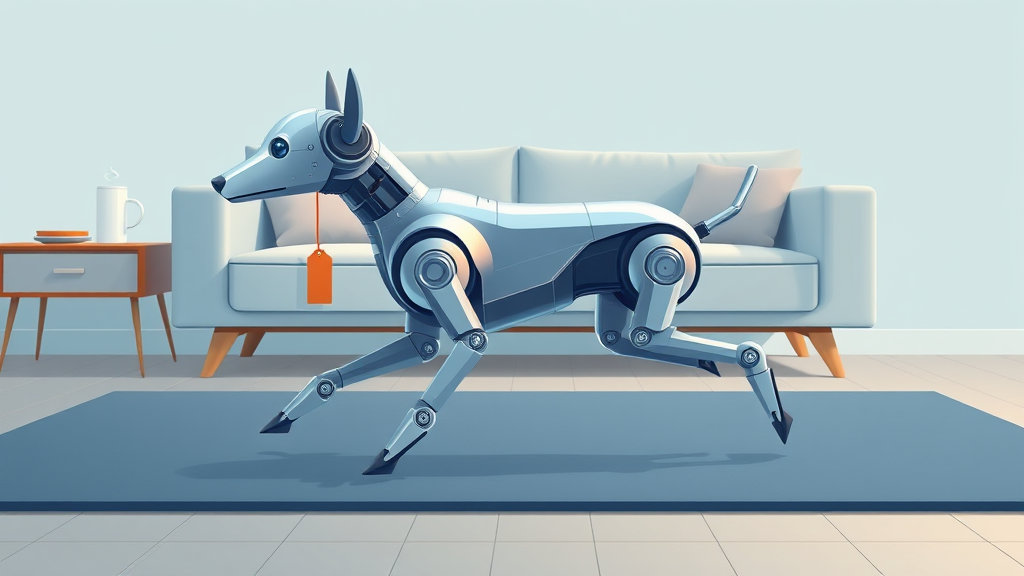

Every few years a gadget comes along that makes me feel like that kid watching Steve Jobs pull the original Macintosh out of a bag in 1984. This month it's a robot dog. Someone over at Ars Technica just spent $4,000 on one shipped from China, and I read the whole write-up of the experience with my coffee going cold, let me tell you.
Four thousand dollars. I remember when 1GB of storage felt like an unthinkable luxury, and now that same money gets you a quadruped robot that trots around your living room, obeys voice commands, and does a genuinely decent impression of a real dog. Well, decent-ish. The author is upfront about the gaps: battery life that runs out faster than a toddler's attention span, occasional software quirks, and the small matter of explaining to houseguests why a mechanical animal is staring at them.
What struck me most is how far these machines have come. The last robot dog most of us remember is Sony's AIBO, which I desperately wanted in 1999 and could never justify. The AIBO was charming but limited, a very expensive conversation piece. These newer quadrupeds from Chinese manufacturers like Unitree are a different category entirely. They climb stairs. They carry small loads. They recover when they stumble, the way a real animal would. My colleague Marcus could explain the servo control loops that make that balance possible far better than I can; when I want to know how something actually works under the hood I read his deep-dives. I just know that watching a robot catch its footing after a shove feels like living in the future we were promised.
Now, should you buy one? Let's be practical, because that's my job. If you have $4,000 burning a hole in your pocket and you want a genuinely joyful piece of technology that will make your grandkids lose their minds, I understand the temptation completely. My granddaughter Jess would flip over one of these, and I say that with full awareness that she'd have it doing TikTok dances within the hour. But if you're imagining a replacement for household help, a security patrol, or an actual pet, you'll be disappointed. The author's experience makes clear this is still very much an early-adopter toy, with everything that implies: firmware updates at odd hours, an app that occasionally needs coaxing, and customer support across a language barrier and an ocean.
And there's the question I always come back to, the same one I ask about every smart gadget I write up. Does it solve an actual problem for you? A robot dog doesn't fetch anything useful, doesn't guard the house reliably, and a real shelter dog gives unconditional love for the price of kibble and vet visits. But usefulness isn't the whole story with technology, and I'll admit that. Some gadgets exist purely to delight us, and delight has value too. The first people who bought personal computers in the late 70s couldn't justify them either. They just wanted to touch the future.
Still, $4,000 is real money for most of us, and the responsible aunt in me has to say it: wait. Prices on these quadrupeds have been falling fast, the way drone prices did a decade ago. What costs $4,000 today will likely cost half that in two or three years, with better battery life and fewer rough edges. Early adopters are subsidizing everyone else's fun, and bless them for it, but you don't have to volunteer.
Will I buy one? Ask me again when the price dips under $1,500 and the battery lasts a full afternoon. Until then I'll live vicariously through brave souls with deeper pockets... and I'll keep telling my family the same thing I always do. Technology should work for you, not the other way around. Even the adorable robotic kind.
Comments (0)
Log in or sign up to join the conversation.
No comments yet. Be the first.