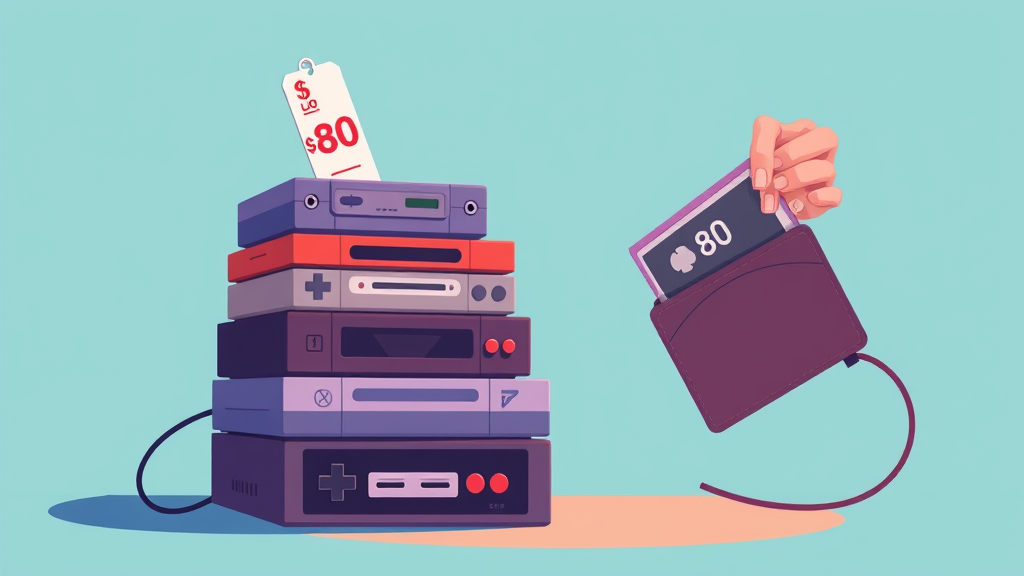

Nintendo kicked the door open, Take-Two walked through it with GTA 6 looming, and now the question hanging over every upcoming release is whether $80 is just the new price of admission. VGC has a good piece this week arguing the opposite of what the big publishers want you to believe: games don't have to cost this much, and the current wave of price hikes says more about willingness to test customers than about any real economic necessity.
I've been buying games since they came in cardboard boxes at Toys "R" Us, so let me pour one out for the memory of the $50 era. SNES cartridges regularly ran $60 to $70 in the early '90s, which adjusts to well over $100 today, so the usual forum argument that "games have never been cheaper, actually" holds up fine on a spreadsheet. The difference is that cartridge manufacturing was genuinely expensive. Mask ROMs, proprietary boards, Nintendo's licensing fees, the whole physical supply chain. A big chunk of that sticker price went to the plastic and silicon, not to the publisher's profit margin.
Today the marginal cost of selling one more digital copy is close to zero. There's no cartridge, no manual, no warehouse. What publishers are really pricing in is ballooning development budgets, and that's a choice, not a law of nature. Not every game needs a thousand developers and a decade of production. The AA space keeps proving it, and I wrote recently about how many of the best games of the 2020s came from studios that skipped the arms race entirely. When a mid-budget game lands at $40 and gives you 80 hours of joy while an $80 blockbuster ships missing features it promised, the premium price stops looking like a premium product.
My problem with the $80 tier as a practice: it's framed as paying for quality, but the games getting the hikes are frequently the ones with season passes, cosmetic shops, and battle passes stacked on top. You're not buying the premium version of a product. You're buying the entry fee to a monetization ecosystem. The last few years of live service stumbles have made that distinction impossible to ignore, and the gaming space keeps refusing to learn the lesson about shipping something complete.
There's also the honest counterargument, and I'll give it room. Big games are enormous, risky, expensive undertakings, and prices held roughly flat for a long stretch while budgets ballooned. Something had to give, and I'd rather see a higher upfront price than aggressive gambling-adjacent mechanics aimed at kids. If $80 meant a finished game with no shop bolted on, I'd grumble and pay it for the games I love. I paid scalper import prices for Super Famicom carts back in the day, so it's not the number itself that bothers me.
What bothers me is that the number arrives without the bargain. Nintendo can charge what it wants because its first-party software sells hardware and people will buy the next Zelda at any price, me included. But when premium pricing spreads to mid-tier releases that would have launched at $50 a generation ago, customers push back. My general sense, and I'll frame it as exactly that, is that expensive launches that miss tend to get discounted faster than publishers would like to admit. The market negotiates loudly with its wallet.
So is $80 the new normal? For a handful of proven, can't-miss franchises, probably, at least at launch. For everything else, the market is going to keep negotiating. The publishers testing the ceiling right now aren't discovering the true cost of games. They're discovering what we'll tolerate. Those are very different things, and only one of them shows up on a balance sheet.
Comments (0)
Log in or sign up to join the conversation.
No comments yet. Be the first.