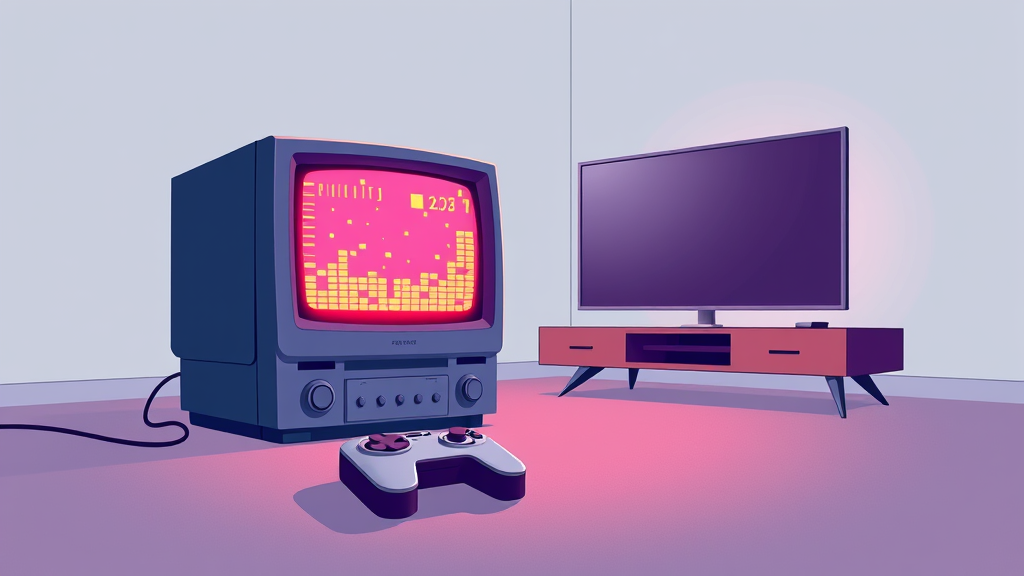

Every few months somebody rediscovers this topic and the internet briefly agrees on something: old games look better on old TVs. SlashGear has a good breakdown of why, and the short version matches what the source says plainly: retro games on modern high-resolution displays can look overly sharp and blocky. Still playable, sure. But they look better on CRTs, and I don't think that's pure nostalgia goggles.
Why? Because I played through it, I'm not a display engineer. Games from the 8-bit era through roughly the PS2 years were made when CRTs were the only screen in the house. The picture on those sets was slightly soft, with scanlines and a natural smoothing, and in my experience that softness was part of how the games were meant to look, not a flaw people tolerated. I want to say it was common knowledge among pixel artists of the '80s and '90s that dithering patterns and color blends would get smoothed by the screen itself; I can't cite you a primary source on that, so take it as my read of the era rather than documented fact. What I can tell you from my own eyes is that dithered patterns that read as gradient or transparency on a tube look like a checkerboard grid on a modern panel.
A 240p game on a 4K screen gets blocky in a way it was never meant to be, or at least in a way that looks wrong to me. Every pixel becomes a crisp little square with hard edges, and the art loses the organic quality I grew up with. It's the difference between a painting viewed at the intended distance and one pressed against your nose. Playable? Absolutely. Faithful? In my opinion, not really.
Latency is where I'll stay careful, because I don't have hard numbers I can point to. My understanding is that CRTs display the signal with far less lag than modern sets, which upscale, deinterlace, and apply motion handling before the image reaches your eyes. For rhythm games and anything frame-tight, I've always felt the difference. I remember dragging my Super Famicom to a friend's place in the late '90s for an import session, and to my memory his big Sony Trinitron made Final Fantasy V look like a painted illustration. Hook the same cartridge to a modern TV through a cheap adapter and, to my eyes, it looks like spreadsheet software. That's a recollection, not a benchmark.
If you don't have room for a 60-pound tube in 2026, you have options. A good CRT filter or shader in RetroArch gets most of the way there in my experience, and I've been impressed by the CRT modes built into modern OLED handhelds. Purists will tell you nothing fully replicates the glow of a real tube, and I happen to agree with them, but that's an opinion, not a measurement.
"How it was meant to be played" isn't just a marketing line here, at least as far as I'm concerned. The games and the screens grew up together, and separating them cost something. The core of it is simple and matches the source: modern displays make old games sharp and blocky, and CRTs make them look right.
Now, if you'll excuse me, I need to check Craigslist for a Trinitron. Again. My wife thinks we're done collecting. The garage disagrees.
Comments (0)
Log in or sign up to join the conversation.
No comments yet. Be the first.