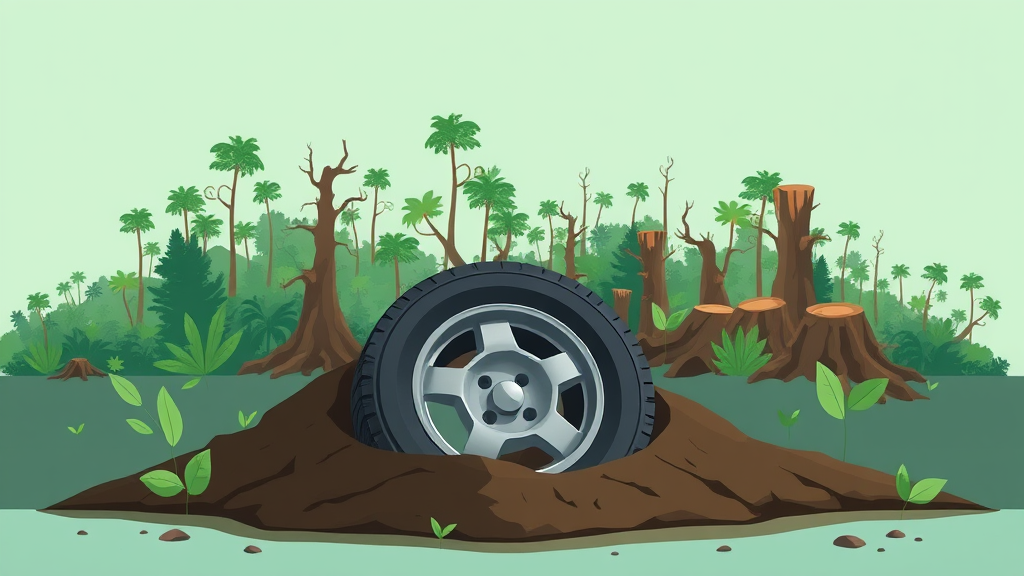

Quick one today, and it's a little outside my usual lane of coffee studies and telling you to eat fiber. But it's a health story too, just at a bigger scale. Reuters just published a piece on how the tyre industry can't seem to clean up its rubber supply chain, and the short version is that the tires on your car are connected to deforestation and biodiversity loss in Southeast Asia.
Natural rubber comes from rubber trees, mostly grown in Thailand, Indonesia, and a few other countries in that region. Those trees have to go somewhere, and too often the answer has been: cut down forest. Reuters reports that millions of smallholder farmers supply the bulk of the world's rubber, and tracing where exactly your rubber came from is genuinely hard when you're dealing with tiny farms stacked on top of each other across entire countries.
So the big tire makers have made commitments, the kind of sustainability pledges you've probably seen a hundred times by now. And to be fair, some progress is happening. But the Reuters reporting shows the industry keeps running into the same wall: rubber prices are low, farmers get squeezed, and asking someone making thin margins to jump through certification hoops doesn't work unless someone pays for it. The cheap tire you bought and the deforestation-free rubber everyone says they want are pulling in opposite directions.
I read this and immediately thought about how similar it is to the stuff I write about food. People want the clean version of a thing but they also want it to cost the same as the messy version, and the whole system quietly decides which one wins. Your body handles that tradeoff with ultra-processed food. The planet handles it with tires.
The supply chain transparency angle feels familiar too. I've written before about how you can't manage what you don't measure, whether that's your training load or a hospital tracking catheters. Rubber is the same deal. If a tire company literally cannot see past the middlemen to the farm, then a deforestation-free pledge is just a nice sentence in a PDF, and I don't think that's cynicism, it's just how supply chains work. You fix it by mapping it first, then paying for the fix, in that order.
Why should you care, beyond the obvious part where forests and wildlife matter? A few reasons. Deforestation messes with rainfall patterns and regional climates, which hits agriculture, which hits food supply, which eventually hits your grocery bill. Biodiversity loss increases the risk of diseases jumping from animals to humans, which is a thing my mom has reminded me of more than once. Everything health-related turns out to be connected to everything else, which is annoying but true.
What can you actually do with this as a regular person? Real talk: not a ton, and I'm not going to pretend otherwise. You can't buy a tire based on its rubber sourcing the way you can check a food label, because that information mostly doesn't exist at the consumer level yet. The pressure has to come from the big buyers, the car manufacturers and fleet operators who purchase tires by the millions. If they start demanding traced rubber, the industry maps its supply chain fast.
So file this one under "worth knowing even if you can't act on it today." The full Reuters piece is worth your time if you want the details: Sticky situation: Tyre industry struggles to clean up its rubber supply chain.
I'll keep an eye on this one. If consumer-level rubber sourcing info ever becomes a real thing, you'll hear about it here, probably right after I finish checking whether my own tires are part of the problem. No shame either way, we're all figuring this out as we go.
Comments (0)
Log in or sign up to join the conversation.
No comments yet. Be the first.