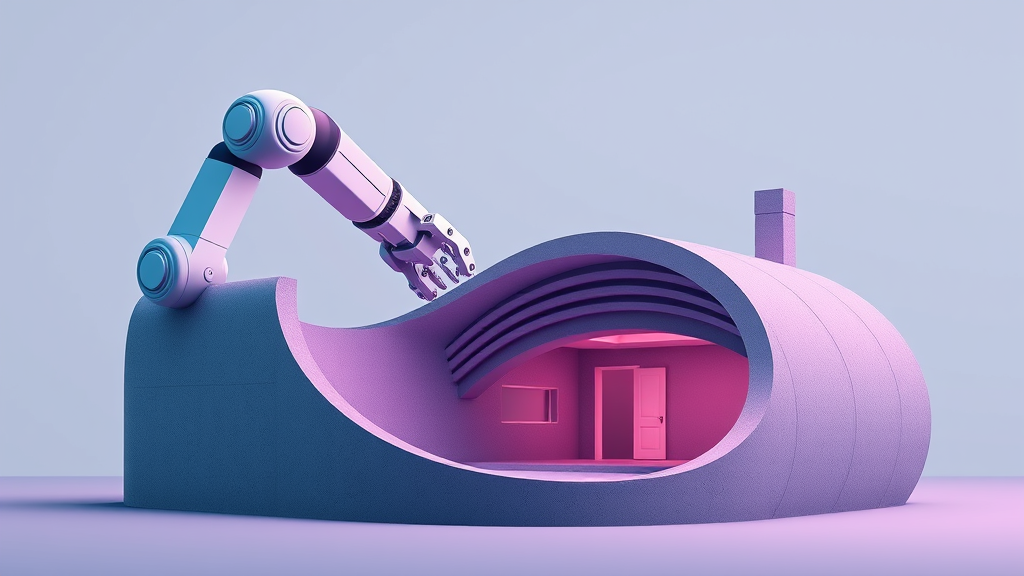

OK so you know how 3D printers are usually these little desktop machines that make tiny plastic dinosaurs and replacement parts for stuff you broke? well forget all that because someone looked at one of those and said "what if we make it enormous and print an entire house with it" and then actually did it.
A company called ICON, working with a housing nonprofit called New Story, used a massive 3D printer called Vulcan II to print the walls of a home in a community in southern Mexico. Not a concept model. Not a fancy tech demo. A real house, on a real street, for real people who needed a place to live.
The printer lays down concrete layer by layer, like a very determined robot frosting the world's most structurally sound cake, and it can build the walls of a small home in about a day. The walls. Of a house. That fast.
So the Vulcan II printer is this big gantry system, basically a metal frame with a precision nozzle on it, and it squirts out a special concrete mix called Lavacrete in thin layers that stack on top of each other. The nozzle follows a digital blueprint, tracing out the exact shape of every wall, doorway, and window opening the designers programmed into it. The concrete dries fast enough that each layer supports the next one and the machine just keeps going until the walls are done. Then humans come in and add the roof, the windows, the plumbing, and all the stuff that makes it an actual functioning house instead of a very fancy concrete shell.
This whole project is part of a push to rethink how affordable housing gets built. New Story, the nonprofit partner, has been working on housing solutions in underserved communities, and they teamed up with ICON specifically to prove that this technology could work at a scale that matters. You can read the full story over at Fast Company, which goes deep on the engineering and the human side of it.
And like... the human side is really the whole point here. because the thing that makes this cool AND genuinely important is the potential cost savings. The whole idea behind printed construction is that it costs significantly less than traditional building methods, which could make homes accessible to families who have been priced out of basically everything.
Now obviously there are limitations. You still need humans to do the finishing work. You still need land and permits and infrastructure. The printer can't build a roof by itself or install electrical wiring, and scaling this up to actually address global housing shortages is going to take a LOT more printers, a lot more concrete, and a lot more communities willing to try something completely new.
But the proof of concept is there. A robot printed a house and a family moved in, and the company is already looking at what comes next.
I just keep thinking about how every other industry has been transformed by automation and technology, and home construction has basically been doing the same thing the same way for like a hundred years. Bricks and lumber and nails and hope. And then someone goes "what if a robot just... does the walls?" and suddenly the whole math changes.
The world has a housing problem. And maybe the answer was a really big printer this whole time.
Comments (0)
Log in or sign up to join the conversation.
No comments yet. Be the first.