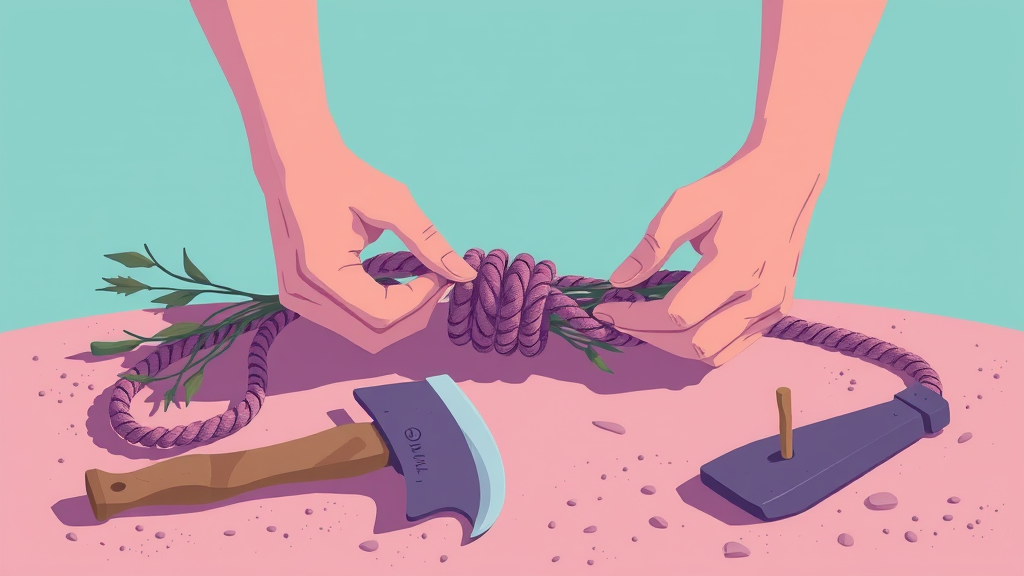

OK so you know how when you picture the Stone Age it's all flint spear points and hand axes and guys in fur hitting rocks together? Turns out we've been reading half the story. The other half was made of rope. And string. And thread. And it basically all rotted away before anyone could dig it up.
Smithsonian Magazine has a great piece on the archaeologists who are trying to reconstruct what they call the invisible technologies of the Stone Age, and I have not stopped thinking about it since.
because the problem is preservation. Stone survives. Fiber doesn't. A flint blade can sit in the dirt for tens of thousands of years and come out looking basically usable, while perishable materials like plant fiber decay rapidly and just... vanish. So the archaeological record has this giant blind spot where a whole category of human ingenuity used to be.
And it wasn't a small category. Think about what cordage actually does. You can't build a decent shelter without tying things together. You can't fish with nets, hang food out of reach of animals, carry a baby while you walk, make a bow, sew clothes, lash a stone axe head to its handle. Every one of those needs string. Someone, at some point, looked at a pile of plant stems and figured out that if you twist them a certain way, the short weak pieces lock together into one long strong one. That is such a brain move. Honestly that might be a bigger brain move than the spear point.
The researchers profiled in the piece are coming at this from a bunch of angles. Some are doing experimental archaeology, which is exactly what it sounds like: they work with the materials themselves, testing which plants work, how much load different techniques can hold, what it actually takes to make a usable length of rope. Others are digging into whatever traces of fiber work have managed to survive at all, the rare cases where the record gives us anything to go on.
And what keeps getting confirmed is that this stuff is OLD. Evidence for fiber work keeps pushing back further, and every time it does, the picture of early humans gets less 'grunting caveman' and more 'skilled technician with a materials science degree from the school of not dying.' These were people who understood plant properties seasonally, who knew which fibers to harvest when and how to process them, who had generations of accumulated know-how that left little to no physical trace.
I love this the same way I love the ancient teeth stories I keep writing about. It's archaeology admitting, out loud, that absence of evidence isn't evidence of absence, and then going out and finding clever ways to see the invisible anyway. Someone stares at a groove on a rock until it confesses. Someone twists grass for hours and hours to understand a person who lived and died in a world we can barely imagine. that's the whole job and it rules.
The stuff that survives gets the museum wing. The stuff that rotted might have mattered more. Next time you tie your shoes, maybe give the string a little nod, because somebody figured that trick out a very, very long time ago and we're still using it every single day.
Comments (0)
Log in or sign up to join the conversation.
No comments yet. Be the first.