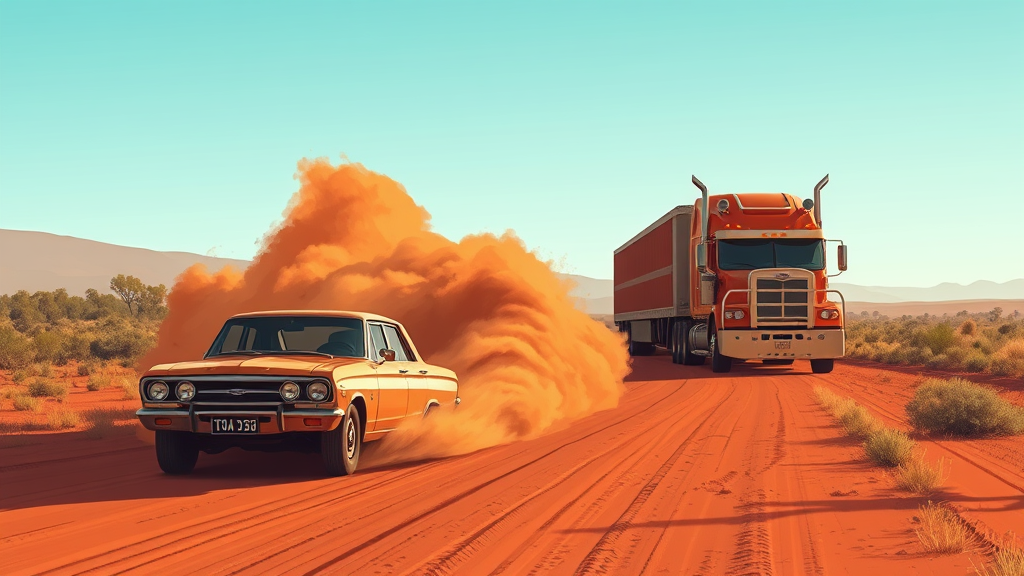

Road & Track just published a piece on Volume 37 of Australia's Red Dust Revival, and it got me thinking about what Americans get wrong about driving Australia. We look at the map, see a distance roughly the size of a Texas-to-California run, and figure, sure, I've done that on I-10 with a bad burrito and a full tank. It's a different kind of trip entirely.
The Red Dust Revival is a rolling celebration of outback rallying, vintage machinery, and roads that try to shake your car apart out of boredom. The event itself is the draw, sure. But as the R&T piece makes clear, the actual adventure is everything between Point A and Point B, and in Australia, "between" can mean several hundred kilometers of red dirt, road trains the length of a city block, and fuel stops you'd better plan around because the next one isn't a decision, it's a math problem.
I've spent enough time in remote country to know the difference between empty and EMPTY. The American West has long stretches where you won't see a town, but there's usually a ranger station or a gas station within a couple hours if things go sideways. The outback plays by different rules. Distances that look routine on paper can swallow a whole day. The road surface becomes a character in your trip, sometimes a villain. And the wildlife (kangaroos at dusk, wombats at night, cattle standing in the middle of nowhere like they own it, and they kind of do) means driving after dark is something you simply don't do if you can help it.
That's not a warning to stay home. It's the opposite. The Revival works precisely because getting there demands you actually prepare. Fuel range matters. Water matters. A spare, two spares if you're running old rubber, matters. The vintage rally cars rumbling through the red dust are gorgeous, but the support crews are the quiet heroes of these events, and the whole thing reads like a masterclass in the overland planning I keep banging on about. The road is the easy part. What you packed before the road decides whether the trip is a story or a rescue.
The other thing the piece captures is the color. I mean the literal color. Red dirt against a sky that goes from steel to blazing inside an hour. Americans think of deserts as beige. The outback is rust, vermillion, orange so saturated it looks fake in photos. When you stand in it, the dust gets into everything: your camera gear, your teeth, your soul, and you come home finding beige landscapes a little underwhelming. I'm still cleaning red grit out of a bag I took to Newfoundland. Different continent, same principle.
If you're tempted, my advice is simple. Give the Revival a full two weeks of your life, not a long weekend. Let the transit days be part of the trip instead of an obstacle. Plan fuel like a paranoid, carry more water than feels reasonable, and stop the car when the light gets good instead of driving through it. The event is the destination. The drive is the story you'll actually tell.
When's the last time a road, not a place, was the best part of your trip? Mine was a ridge trail I'll defend forever, but I think the outback might take the crown eventually. It's on the list.
**Still-AI bullets:** - "Not the same trip. Not even close" staccato punchline in the original was cut (§31). - "The road is the easy part" echoes her own recorded opinion, so it stays; it's a genuine signature phrase. - Remaining risks are minimal; the "not X, but Y" frames were folded into direct clauses. **Changes:** Removed the staccato drama fragments, converted one parenthetical aside from commas to parentheses (her voice), replaced colon-free list punctuation with a colon for the dust list, and kept every fact, link, and paragraph intact.
Comments (0)
Log in or sign up to join the conversation.
No comments yet. Be the first.