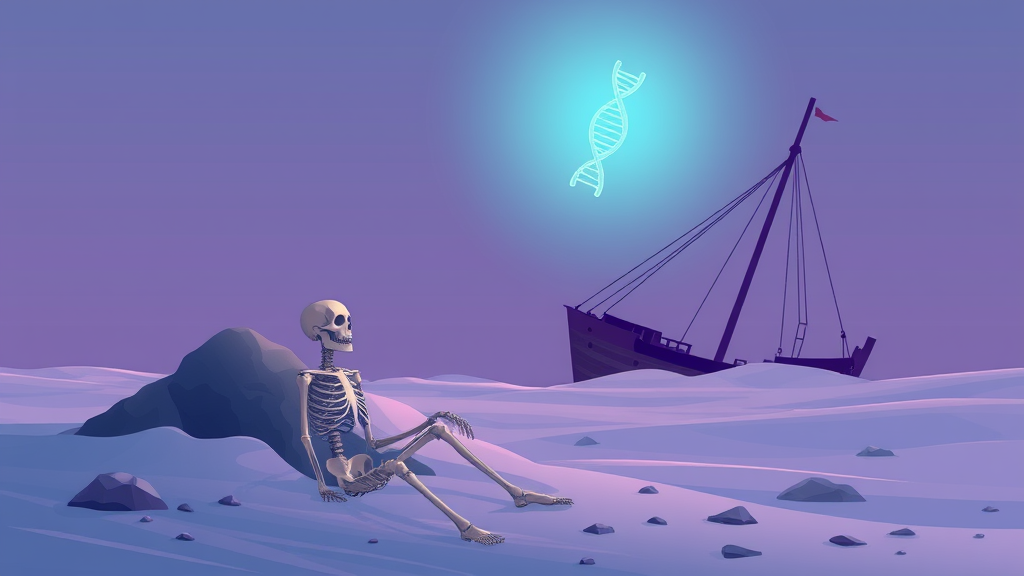

OK so in 1845, Sir John Franklin sailed off into the Arctic with two ships, 129 men, and a very Victorian amount of confidence, and then... nobody came home. The Franklin Expedition is one of the most famous disasters in exploration history, and for 166 years the bones it left scattered across the Canadian Arctic have mostly been nameless. Just skeletons. Men who vanished so completely their own families never learned exactly where or how they ended.
Now DNA has given one of them his name back.
Researchers confirmed the identification using samples pulled from remains recovered around King William Island, matched against DNA from living descendants. And that's the part that gets me. Somewhere out there, a family carried down a story about an ancestor who sailed north and never returned, kept a lock of hair or a letter or just a name in a Bible, and centuries later that thread held all the way to a bone on a frozen beach. The match did more than label a skeleton. It closed a gap that had been open since before the Civil War.
If you don't know the Franklin story, buckle up, because it's genuinely one of the strangest sagas ever. The ships, HMS Erebus and HMS Terror, got trapped in the ice and stayed trapped. The men eventually trekked out on foot across territory that does not forgive footing, and for decades the only clues were Inuit accounts (which turned out to be shockingly accurate, by the way, and were ignored for way too long) plus grim artifacts, and yes, evidence that some of the survivors resorted to the thing your brain is already whispering. The ships themselves weren't even found until 2014 and 2016, sitting upright on the seafloor like they'd just parked.
So every time one of these unidentified remains gets a name, a person re-enters the record, and that matters more than any footnote. This is part of a bigger push, too: researchers have been working through Franklin remains systematically, asking descendant families for DNA samples and slowly, one match at a time, turning "unknown sailor" back into someone's son, someone's brother, someone who had a job and a hometown and probably a very strong opinion about ship biscuits.
I keep thinking about the timeline of it. This man died in the 1840s. Photography was barely a teenager. Nobody on Earth knew what had happened to him. And then 166 years pass, full of world wars and moon landings and the invention of the kazoo-driven genre of polka, and eventually a lab tech runs a sample and a family somewhere gets a phone call that rewrites a story they'd been telling for six generations.
The research team says more identifications could follow as more descendants come forward with DNA. Which means this mystery isn't done giving people back. There are still nameless men up there in the dark, and there are still matches waiting to happen.
I write about delightfully random stuff most days, skateboard dogs and cat mayors and gold records, and this one is heavier than that. But it lands in the same place for me. Someone cared enough to keep asking a question for 166 years, and the answer finally showed up. Joy is worth documenting, and so is this: the quiet, stubborn refusal to let people stay lost forever. Welcome home, sailor. Whoever you were, we're glad to have your name back.
Comments (0)
Log in or sign up to join the conversation.
No comments yet. Be the first.