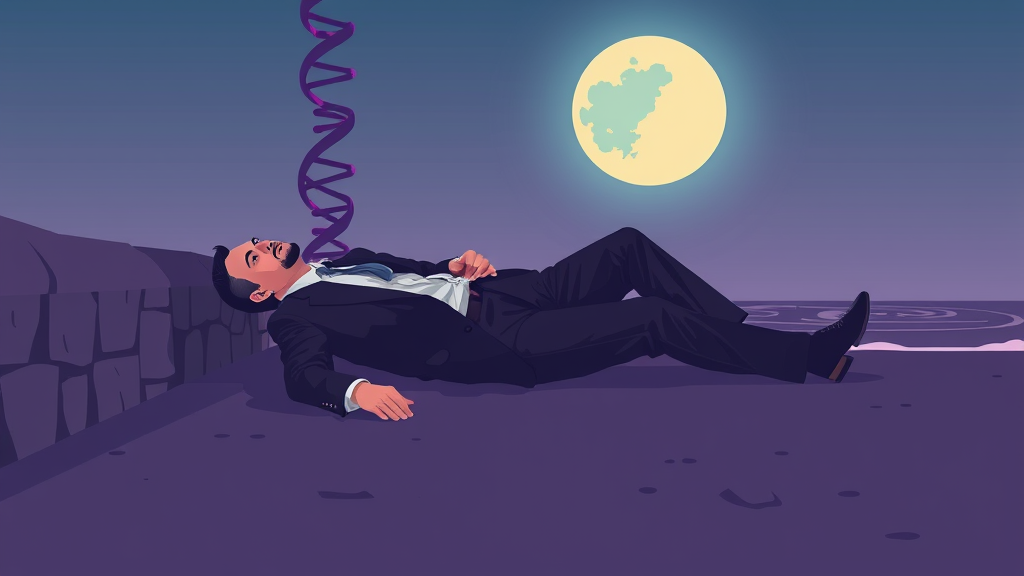

OK so a man in a suit walks onto a beach near Adelaide, Australia, on a summer night in 1948, sits down against a seawall, and never gets up again. That is not the opening of a novel that is the actual beginning of one of the strangest cold cases in history, and after nearly 80 years we might finally know his name. Popular Mechanics has the whole story, and I've been completely absorbed in it all morning.
The body turned up at Somerton Park on December 1, 1948, and the details are the kind of thing you couldn't invent if you tried. The man was well-dressed. Every single clothing label had been cut out or was missing. No wallet, no ID, nothing. And tucked into a hidden pocket sewn into his trousers was a tiny scrap of paper reading "Tamám Shud," which is Persian for "it is finished," and it had been torn from a copy of the Rubaiyat of Omar Khayyam. Like. A hidden pocket. Who sews a hidden pocket.
It gets weirder. Police tracked down the actual book the scrap came from, and inside it was a code, five lines of faint penciled letters that nobody has ever conclusively cracked. There was also a phone number, which led detectives to a woman living nearby who, when shown a death mask of the man, reportedly acted like she recognized him and then basically clammed up forever. She denied knowing him. For the rest of her life. Just watch it.
And the autopsy? Nothing. No cause of death anyone could pin down. No poison definitively detected. A healthy middle-aged man whose heart simply stopped on a beach, and decades of investigations, theories, and true-crime obsession later, we still didn't know who he was. The case became known as the Somerton Man, and it's basically Australia's answer to the unidentified flying objects of the world: the mystery everyone has a theory about and nobody can prove.
Except now, maybe, we can. Because the story takes a turn that makes me unreasonably happy: researchers including Derek Abbott, a professor at the University of Adelaide, spent years pushing to exhume the body and run modern DNA analysis, and in 2022 the South Australia attorney-general actually approved it. Abbott and a team used DNA extracted from hair roots preserved in the death mask, ran it through genealogy databases the same way investigators cracked the Golden State Killer case, and came back with a name: Carl "Charles" Webb, an electrical instrument maker from Melbourne who'd been missing since 1949 and had a broken marriage in his past. A name!! After all that!!
The identification hasn't been formally signed off by police yet, which is why I say almost, but the genealogical work lined up siblings, descendants, the whole family tree. Researchers are still tightening the final confirmation and there have been challenges to the findings along the way, so the last chapter isn't officially closed. Still. Eighty years of a man with no name, and now there's a name on the table.
I keep thinking about the cut-out labels. Whoever he was, he (or someone) didn't want him identified, and for 80 years it worked. And now a bit of preserved hair and a genealogy database have done what five decades of detectives couldn't. Joy is worth documenting but so is this, you know? Every weird mystery getting its answer is a good day for the world.
If the Webb identification is confirmed, the big question shifts from who to why, and the why might stay open forever... and I think I'm fine with that. Some mysteries deserve to hand you an answer and then leave one small door unlocked. But every unidentified person deserves their name back, even 80 years late. Especially 80 years late.
Comments (0)
Log in or sign up to join the conversation.
No comments yet. Be the first.