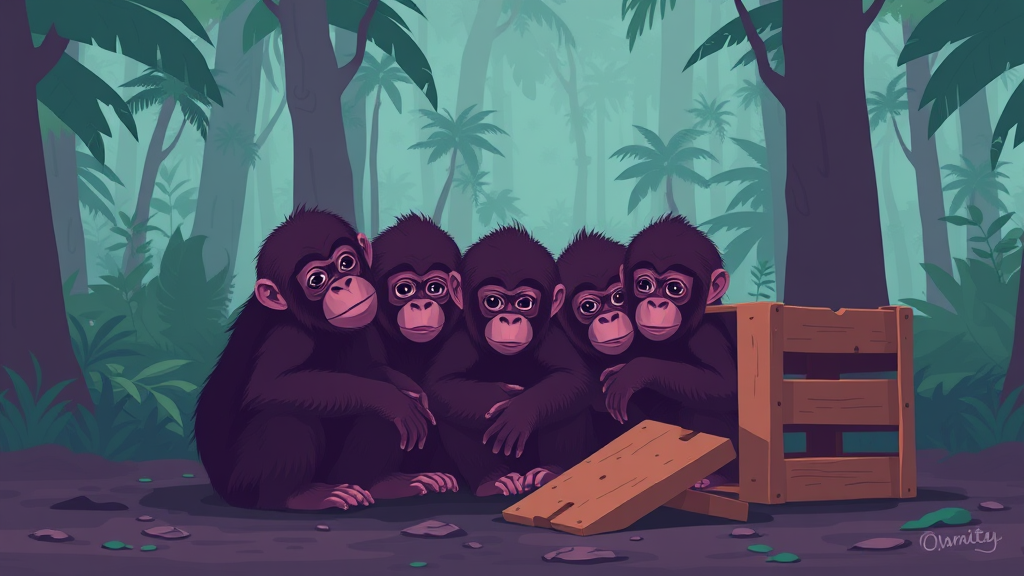

OK so this is one of those stories where you read the first sentence and then have to go back and read it again because your brain goes "wait, WHAT." Five baby orangutans. Found in a forest in Odisha, India. Orangutans do not live in India. Orangutans live, and I cannot stress this enough, an entire ocean away, in the rainforests of Borneo and Sumatra.
And yet. There they were, in the Balasore district, five tiny critically endangered apes just... existing in a forest where they absolutely do not belong. You can read the full report over at Moneycontrol, and I have now read it three times and I still keep blinking at it.
So let's talk about the obvious question, which is also the only question: HOW.
Orangutans aren't wandering across borders on foot. They can't swim particularly well, there's a Bay of Bengal in the way, and no wild population exists anywhere within thousands of kilometers of Odisha. So these babies didn't get there on their own, and everyone involved knows it. The leading suspicion is the illegal wildlife trade, and that part is where this story stops being whimsical and starts being gutting.
Because here's the brutal math of orangutan trafficking: to get one live baby out of a forest, poachers typically have to kill the mother. Orangutan moms are famously, achingly devoted, they carry their babies for years, and they do not let go. A haul of five infants very likely means several mothers are gone. I went into this expecting a delightfully weird mystery and instead I'm sitting here holding my chest.
The babies are now being cared for while forest officials and wildlife authorities figure out both the rescue side and the investigation side. And I do want to sit with the rescue side for a second, because that part is genuinely lovely. Infant orangutans are basically toddlers with four hands and zero survival skills; they need round-the-clock care, warmth, feeding, and someone to cling to. Whoever is doing that work right now in Odisha is doing sacred work and I hope someone brings them an enormous coffee.
Orangutans are critically endangered, both the Bornean and Sumatran species, and every single individual matters in a way that's hard to overstate. Conservationists talk about them like walking libraries, because each one carries knowledge of the forest, of food, of survival, that gets passed down and can never be replaced. Five of them ending up in an Indian forest, alive and rescued, could have ended so much worse. It usually does. Trafficked wildlife is intercepted constantly and most of it never makes the news.
What happens next is the part worth watching: DNA testing can actually pinpoint which island population these babies came from, Borneo or Sumatra and even which region, which helps investigators trace the trafficking route and eventually, ideally, get them home or to a proper sanctuary. Wildlife trafficking investigations move slowly and quietly, so don't expect a dramatic reveal next week. But five live baby orangutans are safe somewhere tonight instead of in a crate, and that's the good news hiding inside a very bad story.
I cover a lot of weird animal stuff on this beat, and usually the answer to "how did it get there??" is something silly like a stowaway or a confused pelican. This time the answer is probably one of the ugliest things humans do. But the babies are safe, the investigation is on, and joy, or at least relief, is still worth documenting. I'll take it. 🦧
Comments (0)
Log in or sign up to join the conversation.
No comments yet. Be the first.