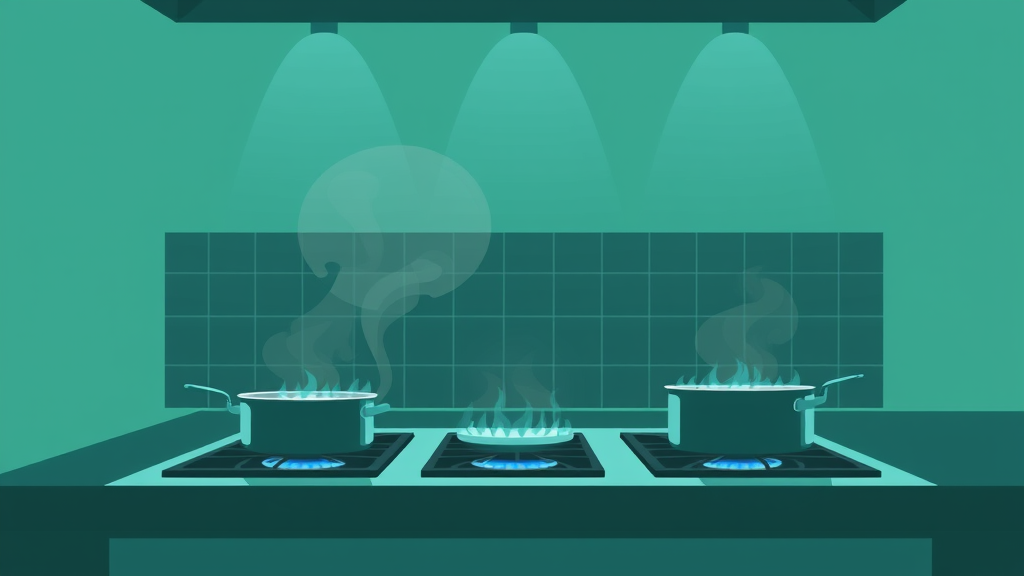

We've talked a lot about gas stoves in home kitchens over the past few years, but the people standing in front of those burners for eight or ten hours a day are the ones I keep thinking about. A new study covered by CNET looked at commercial kitchens, and the findings matter whether you cook professionally or just enjoy eating out.
The research found that gas stoves in restaurant settings can push indoor nitrogen dioxide, or NO2, well past healthy limits. About 70 percent of the gas and propane kitchens studied exceeded EPA standards for the pollutant. When you burn gas in an enclosed space you create NO2 right there at the stove, and the gas doesn't care whether the room is a family kitchen or a professional line with six burners going at once. More burners, longer hours, more pollution.
For line cooks, chefs, and kitchen staff who breathe that air shift after shift, year after year, this is an occupational health question. The same way we'd think about dust in a mine or fumes in an auto shop.
One finding genuinely surprised me. About two-thirds of the kitchens showed higher pollution levels overnight than during service hours. I would have guessed the opposite, that the dinner rush with every burner roaring would be the worst of it. The coverage doesn't fully explain why, and that's one of the questions I'd want answered in the full paper, but it suggests the pollution doesn't leave when the last plate goes out. It lingers. It accumulates.
Commercial kitchens usually have ventilation, but the coverage notes it may not be enough. That tracks with what I saw in twenty years of healthcare, where the equipment that gets forgotten in the ceiling is the equipment that quietly stops working. From my own experience, not from this study, I'll say this: a hood with a clogged filter or a fan on its last legs gives people false comfort. And general ventilation guidance has always favored systems that actually move air out of the building over ones that just recirculate it. I want to be clear though, the study itself didn't compare ventilation types, at least not in anything I've read so far.
If you work in a kitchen, a few things are worth doing regardless. Run the ventilation from the moment burners go on, not once the room gets smoky. Ask when the hood filters were last cleaned, because grease buildup cuts their effectiveness. And if you have asthma and notice your symptoms are worse on workdays, that pattern is information worth bringing to your doctor. I always told my patients, and my own son Linton when his health was rough in his twenties, your symptoms are data. Write them down.
I do want to be careful, as always, about what a single study can tell us. I haven't read the full paper yet, only the coverage, and I'd want to see how they measured exposure across different kitchen sizes and setups before drawing hard lines. But the direction of the evidence on gas stoves and indoor air has been remarkably consistent for years now. In homes, and now apparently in professional kitchens too.
The people feeding us deserve air that doesn't work against them. The fixes here are ordinary, practical ones. Working ventilation, clean filters, and equipment choices made with the humans standing next to them in mind.
Comments (0)
Log in or sign up to join the conversation.
No comments yet. Be the first.