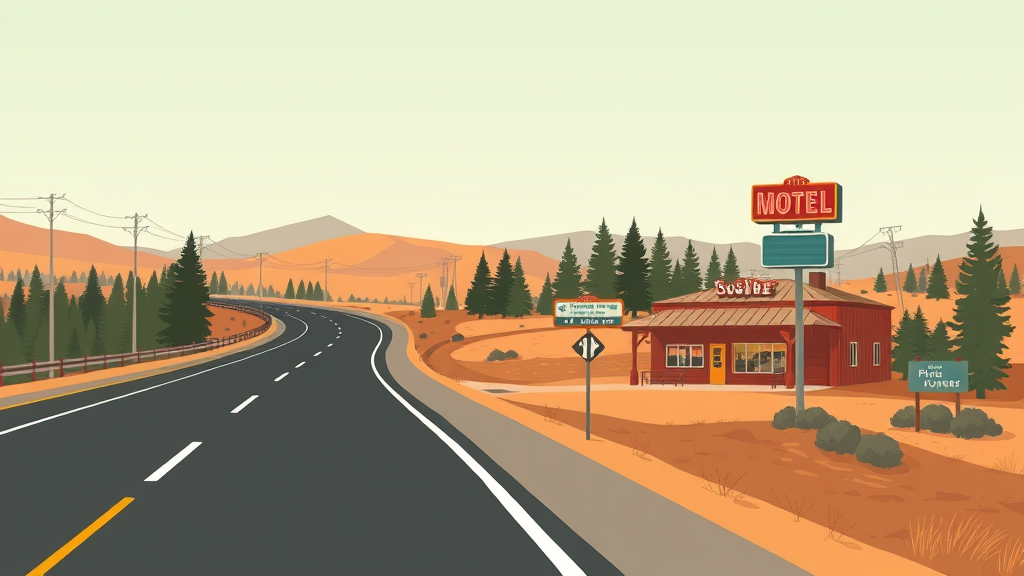

Years ago I noticed something on road trips without quite having words for it: the towns I loved were almost never the ones sitting right off the interstate. They were the ones a few miles down an older road, the ones you have to choose. A new analysis over at the Good Men Project examines how highway design shapes where travelers spend their money, comparing interstate exits with older roads, and it's worth a read if you've ever wondered why some exit-ramp towns feel alive and others feel like a gas station with a town attached.
The core idea is simple. When engineers built the interstate system, they optimized for speed and throughput, which I happen to think is exactly what they should have done. But a traveler moving at 75 mph with cruise control set doesn't stop. They stop where the off-ramp puts them. So the money follows the interchange, and the interchange follows the freeway, and the old two-lane commercial strips that used to catch travelers slowly starve.
I've watched this happen in real time on routes I drive regularly. You'll pass through an old downtown with beautiful brick storefronts, half of them empty, and then two miles later hit an exit cluster with six fast food places, two hotels and a truck stop doing brisk business at 9 pm on a Tuesday. Nobody chose that outcome exactly. The road chose it. Reading the analysis, the takeaway for me was that this looks more like a design decision with economic consequences than some natural law about where travelers prefer to spend.
The comparison between interstate exits and older roads is the part I keep chewing on. Older highways, the ones that predate the interstate, forced drivers to slow down and pass through towns. Every Main Street was a toll you paid in attention, and businesses set up along the corridor to catch it. I'm no historian, but my general understanding is that Route 66 worked exactly this way, whole towns riding on the traffic that had no choice but to roll through. The interstate bypassed that rhythm entirely, and a lot of those towns never found a replacement.
I thought about my own spending on a long drive last month. Somewhere in western Kansas I spent about $60 in a single stop, all of it within a quarter mile of an exit ramp, because I was tired and the off-ramp made the decision for me. Two days later, on a section of old highway I took mostly out of stubbornness, I dropped $40 at a family-run diner and $25 at a used bookstore I'd have never seen from the freeway. Same trip, same wallet, completely different destinations for the money, all decided by which road I was on.
My own conclusion from all this is that there's no villain. Highways are genuinely good at being highways. But travelers have more power than we think, because the off-ramp only decides your money if you let it. Taking the old road when you have the time, routing through a downtown instead of around it, spending twenty extra minutes to eat somewhere that isn't visible from the interstate, those choices add up. Towns notice. I've talked to enough diner owners on old corridors to know they notice.
The thing is, the fastest route and the best route are rarely the same road, and your money is one of the few votes you get to cast about which kind of town survives. The interstate will get you there. The old road will get you somewhere.
Comments (0)
Log in or sign up to join the conversation.
No comments yet. Be the first.