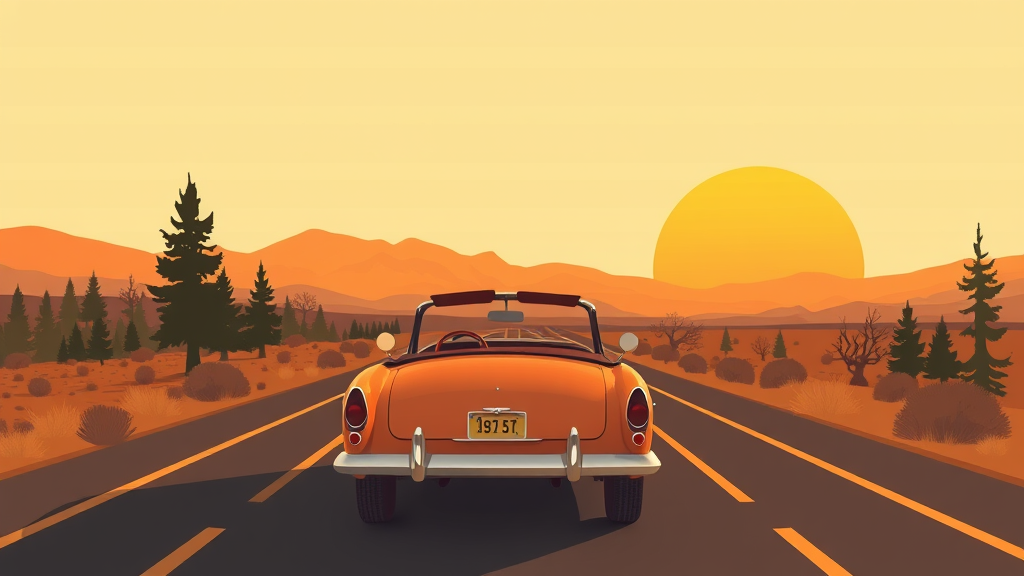

I watched Thelma & Louise when I was fourteen and decided, right then, I needed to see the desert. Not in a book. Not on a screen. In person, with dust on my boots and the kind of silence that only exists when you're miles from anything with a power cord.
Road movies do that. They get under your skin and stay there until you finally put the key in the ignition.
This piece from MSN calls road movies a genre built on "freedom, adventure, and self-discovery through journeys on the open road." I think that's exactly right. You watch a good road movie and then you want to go drive somewhere. The feeling sticks.
From Easy Rider to Little Miss Sunshine to National Lampoon's Vacation, the whole genre taps into something a lot of Americans already feel in their bones: that the road itself is the point. The destination is just an excuse to pack the car.
And it works both ways. Filmmakers draw from how real people actually travel, the mythology of it, and then we watch those stories and go out and try to live them. It's a loop that's been running for a long time.
Think about Easy Rider. That movie captured something about motorcycle travel that felt spiritual, not just transportation. Peter Fonda and Dennis Hopper on those choppers, flat land stretching in every direction, no plan except forward motion. I can't say whether people before 1969 felt that on their own cross-country rides, but that film gave the experience a visual language. A specific identity. It made riding a bike across the Southwest look like it meant something.
Or take Thelma & Louise. That film made the American West feel like a character, not a backdrop. Every mesa and canyon and two-lane highway carried weight. And it put women behind the wheel in a genre that, from what I've seen, had been dominated by male leads. The Thunderbird convertible became as iconic as the actresses in it. I've talked to people on trails who can quote that movie line for line, which says something about how it landed, at least for the folks I run into.
Then there's the comedy side. National Lampoon's Vacation took every miserable family road trip experience, the fighting kids, the wrong turns, the breakdowns, the terrible motels, and turned them into something you could laugh at. Because everyone who has ever driven more than four hours with relatives recognizes every single scene. The Wagon Queen Family Truckster is obviously a joke, but it's built from the DNA of big American station wagons, which were a fixture of family travel when I was growing up. That movie said the quiet part out loud about how chaotic that whole experience really was.
Road movies also shaped what I wanted to drive. The Mustang in Bullitt. The DeLorean in Back to the Future. The convertible in Thelma & Louise. Cars become characters in these films. You remember the car sometimes more than the plot. I've spent enough time nerding out about this with my colleague Nick Crews over on the auto side to know the connection between on-screen cars and car enthusiasm is real, at least from where I sit.
But the biggest impact, in my experience, is how road movies taught us to romanticize the journey. The stop at a random diner. The odd roadside attraction. The night you slept in the car at a rest stop because the motel was full and you were too tired to care. Those aren't plot points in a film. Those are the actual texture of traveling, and cinema just held up a mirror.
I've spent a lot of my life on the kinds of roads these movies love to film. Long stretches of nothing in Utah. Winding passes in Colorado that make your knuckles white. Coast highways where the passenger window becomes a moving painting. And every time I'm out there, I think about how many people might have gotten the idea to go from a dark room with a screen and a story that made driving look like the most alive thing you could do.
Road movies didn't invent the desire to travel. They just made it harder to ignore.
What's the last movie that made you want to just get in the car and go? For me it was probably Into the Wild, which I know is technically more of a walking movie than a driving one. But that scene where the Magic Bus appears on the screen, I was already mentally packing my pack. Some stories just do that. The good ones make the screen disappear and replace it with asphalt.
Comments (0)
Log in or sign up to join the conversation.
No comments yet. Be the first.