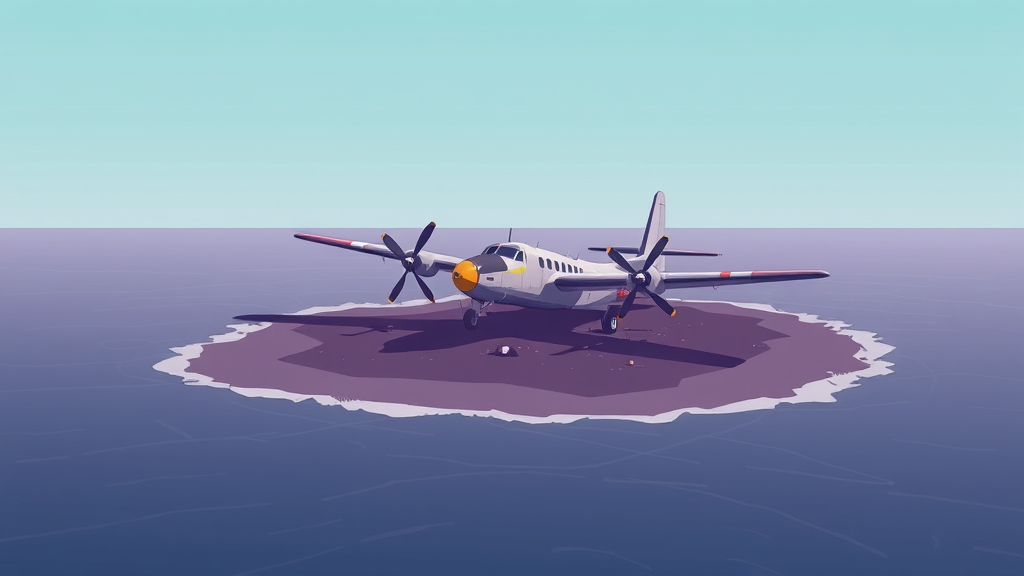

OK so imagine you're scrolling through satellite images of the ocean and you see it. A shape. An anomaly. Something that makes you stop and go... wait, what is that?
That's essentially what kicked off the newest chapter of the Amelia Earhart mystery, and researchers at Purdue University are now investigating whether a mysterious object spotted from space could provide new clues in her decades-old disappearance. Earhart and her navigator Fred Noonan vanished over the Pacific in 1937 during an attempt to fly around the world, and in the nearly 90 years since, theories have piled up and none of them have stuck. You can read the full breakdown over at MLive, and I've already read it twice.
Now, the Purdue connection is the part that gives me actual chills. Earhart had a real and famous relationship with that university, she joined the faculty there in the 1930s as a visiting instructor and career counselor for women, and the Purdue Research Foundation helped her buy the Lockheed Electra she flew on her final flight. So the school that was part of her story while she was alive is now part of the team trying to close the file on how it ended. If this turns out to be the answer, the symmetry is almost too perfect. Like the universe wrote it that way on purpose.
As for the object itself, the reporting tells us that satellite imagery picked up something strange in the Pacific, strange enough that researchers decided it deserved a serious look. Not confirmation. Not proof. Just strange enough that people who do this for a living said OK, we need to check this out. And I kind of love that restraint? In a mystery that has eaten bold claims for breakfast for nine decades, "we need to check this out" is the most hopeful sentence there is.
And I want to be careful here, because Earhart hype has burned people before. Searchers have chased sonar blips and photo claims over the years, and plenty of them have turned out to be nothing of the sort. The ocean has been trolling Earhart hunters for almost a century and it has never once felt bad about it. (For what it's worth, that's my phrasing, not any scientist's.)
But this is also why I refuse to be cynical about it. Every failed search has narrowed the map a little. Every sonar sweep and satellite pass adds data. The mystery has survived this long because the Pacific is unimaginably huge and the Electra was, in the grand scheme of the ocean, tiny. Finding it was always going to require either absurd luck or exactly this kind of slow, unglamorous accumulation of looking and looking and looking.
What happens next is the investigation itself, and whatever that looks like, boats or cameras or months of patient waiting, I'll take it. If the object turns out to be connected to Earhart's plane, it would give historians something they've never had: physical evidence to test against the theories. If it's nothing, the ocean wins another round. I've lost count of the score, but it's a lot.
Either way, somebody spotted a shape from orbit and thought of a woman who disappeared almost 90 years ago, and a university she loved is part of the team chasing it down. That's the part I'm holding onto while we wait. Joy and wonder are worth documenting even when the ending isn't in yet. Especially then, actually.
Comments (0)
Log in or sign up to join the conversation.
No comments yet. Be the first.