
OK so this one comes from Mysteries Unearthed with Danny Trejo (yes, THAT Danny Trejo, and yes I love this for him) and it is one of my favorite science stories ever, so I'm so happy it's getting airtime again.
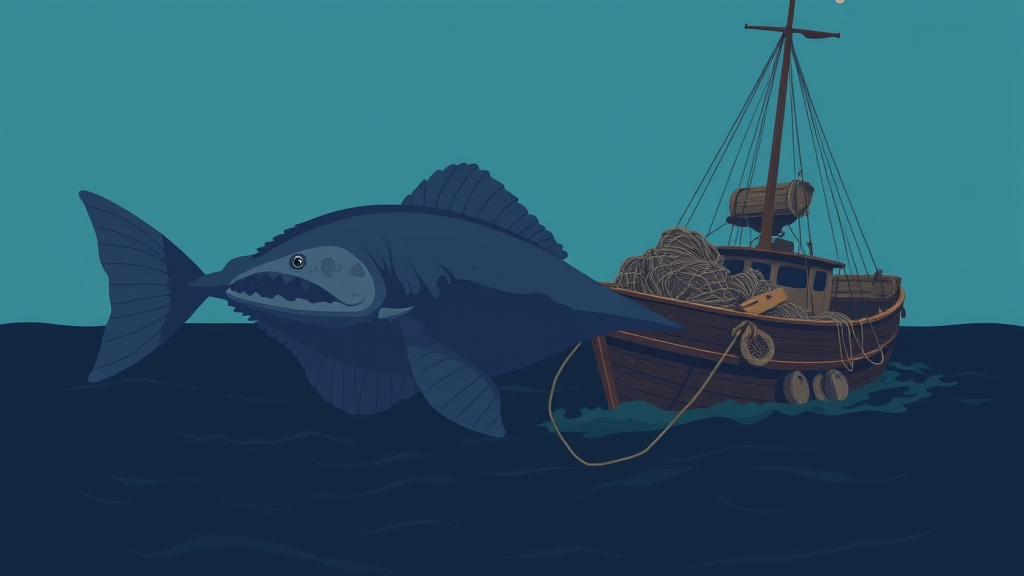
December 1938. A fishing trawler pulls into East London, South Africa, and among the haul is this bizarre five-foot-long fish nobody can identify. Slate blue, armored in thick weird scales, with limb-like lobed fins, and it looks like it swam straight out of a textbook illustration of the Devonian period. Because basically? It did.
A young museum curator named Marjorie Courtenay-Latimer took one look and knew it was special. Late December 1938, days before Christmas, she's rifling through a fish pile because she collected specimens for her museum, and there it is. She sketched it, hauled it into a taxi (a FISH. in a TAXI.) and sent her drawing to a chemist named J.L.B. Smith who was also a fish expert. His cable back is legendary: "MOST IMPORTANT PRESERVE SKELETON AND GILLS = FISH DESCRIBED."
What she'd found was a coelacanth. A lineage of fish scientists believed had gone extinct about 65 million years ago, back when the dinosaurs clocked out. Not endangered. Not rare-ish. Extinct, extinct, in the textbooks, case closed, for over a century of ichthyology.
And then one just... shows up. On a boat. In 1938.
Smith spent the next 14 years hunting for a second one, and in 1952 a fisherman off the Comoros Islands caught another. Since then coelacanths have turned up living in deep waters off East Africa and Indonesia, quietly existing several hundred feet down this whole time, doing their slow ancient thing while the entire scientific world had written their obituary millions of years early.
And here's the detail that gets me every time. Coelacanths don't lay thousands of eggs like most fish. They give birth to live young, and everything about how they live is slow and unhurried in a way that feels almost defiant. The whole world wrote them off and they just kept swimming.
People call these "living fossils," which I get, but I think that phrase undersells it. A living fossil sounds like a leftover. What a coelacanth actually is, is a direct unbroken connection between us and a world 400 million years old. Those lobed fins are related to the limbs that eventually walked onto land. You are looking, through very thick glass, at a distant cousin of the ancestor of every animal that ever climbed out of the sea. Including you. Including your cat. Including Danny Trejo.
The whole episode is also why I'll never fully trust the word "extinct" without a little asterisk in my heart. The ocean covers most of the planet and we've explored a comically small slice of the deep parts of it. The coelacanth hid for 65 million assumed years. What else is down there politely avoiding us?
If you want the full segment it's worth the watch, if only to see Trejo narrating deep sea mysteries, a sentence I never expected to type and am delighted I get to.
Anyway. Marjorie Courtenay-Latimer saw a weird fish in a pile days before Christmas and refused to look away, and because of that, science got one of its greatest plot twists ever. Curiosity is the whole engine. Joy is worth documenting and so, it turns out, is one weird blue fish.
Comments (0)
Log in or sign up to join the conversation.
No comments yet. Be the first.