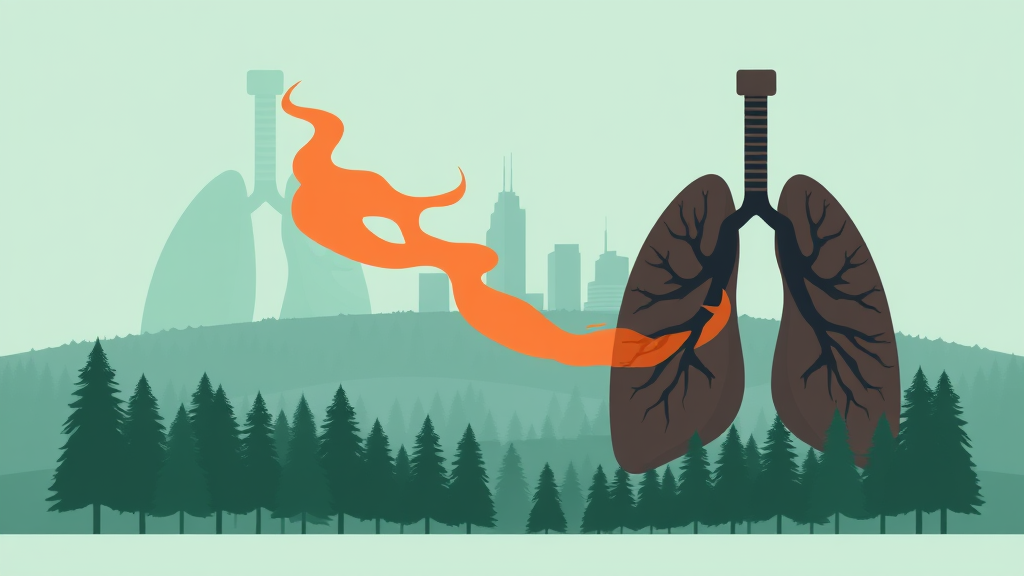

If you've ever noticed that wildfire smoke feels different from ordinary city smog, your body may be onto something. Researchers at the Icahn School of Medicine at Mount Sinai published two studies this month suggesting wildfire smoke isn't just another form of air pollution. It may be measurably more harmful, and the reasons why are worth understanding if you live anywhere near a fire-prone region, which these days is a lot of us.
The findings, reported by Medical Xpress, get at something I used to wonder about during my nursing years. Patients would come in during smoke events with symptoms that seemed out of proportion to the air quality index. The number said "moderate," but the person in front of me was wheezing like it was a bad air day in July.
So why would smoke from a burning forest hit harder than tailpipe exhaust? A few things. Wildfire smoke particles tend to be extremely small, fine enough to slip deep into the lungs and even into the bloodstream. The smoke also carries a complex chemical stew, everything from burned vegetation compounds to whatever was in the path of the fire, plastics, buildings, treated wood. And it tends to arrive in intense bursts rather than the chronic low-level exposure we associate with traffic pollution. Your body gets a big dose all at once, with little time to adapt.
The Mount Sinai researchers found associations between wildfire smoke exposure and worse health outcomes compared with other particulate pollution at similar levels. That last part matters. Fires don't only produce a lot of pollution; the same amount of wildfire particulate appears to do more damage than the same amount from other sources.
Who should pay the most attention? People with asthma, COPD, and heart disease, first. Older adults. Pregnant women. And children, whose lungs are still developing and who breathe faster per pound of body weight than we do. If that list sounds like most of the people I cared for over twenty years, well, it is.
What can you actually do with this information? The practical advice hasn't changed, but the stakes might be higher than we thought. Check the air quality index during fire season, and consider being more cautious on smoke days than the color coding suggests. A good HEPA filter in the bedroom helps, and keep windows closed when smoke is heavy. If you have a rescue inhaler, keep it close. And don't exercise outdoors hard during smoke events, even if you feel fine, because heavy breathing pulls those particles deeper into the lungs.
One caution from me, in the spirit of reading past the headline. I've only seen the coverage of these studies so far, not the full papers, and I want to look at how the researchers separated wildfire smoke from other pollution sources before I call this settled. Exposure measurement in these studies is genuinely hard, and people who live near fires often face other health pressures too. That doesn't undercut the findings. It just means I like to see them replicated before rewriting the rulebook.
Still, the direction of the evidence has been pointing this way for a while now. My son Linton lives out west, and during bad fire seasons I find myself texting him about air quality more than any mother probably should. Turns out maybe that nagging was backed by science.
Fire season isn't getting shorter. Knowing that smoke deserves extra respect, not the same shrug we give a hazy summer day, is a small thing. But small things, done consistently, protect lungs.
Comments (0)
Log in or sign up to join the conversation.
No comments yet. Be the first.